
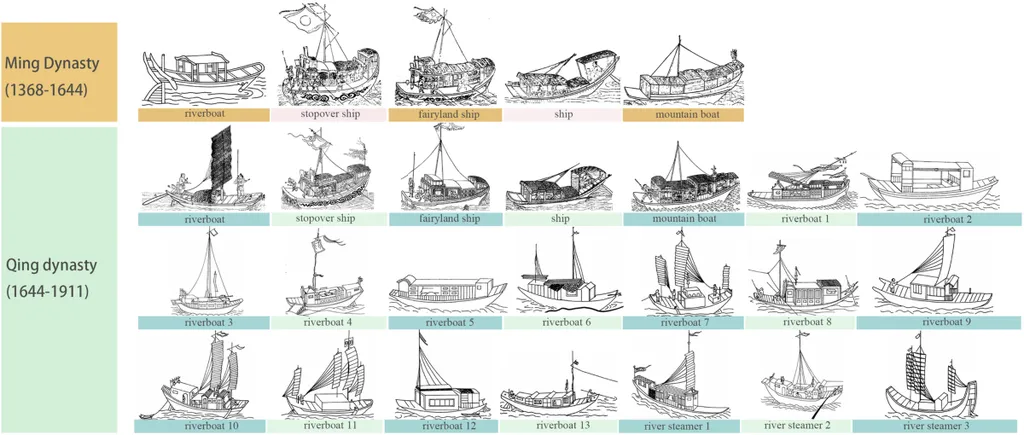
In the vast and complex tapestry of maritime history, the evolution of merchant ships often reflects the geopolitical and economic currents of their time. A recent study published in the open-access journal PLoS ONE, titled “Tracing the geopolitical influences on the morphological and functional transformation in Guangdong merchant ships: Knowledge mining from the Ming and Qing maritime archives,” sheds light on how these factors shaped the design and function of ships in Guangdong during the Ming and Qing dynasties. The lead author, Jinghui Ao, whose affiliation is not specified, employed text mining techniques to uncover these historical nuances.
The study, which used word frequency analysis and co-occurrence network modeling, reveals that economic and military needs were the primary drivers of ship design. Political and geographic factors, while secondary, played a supportive role. For instance, the increased piracy threats in the South China Sea led to structural reinforcements for defensive purposes. Meanwhile, policy shifts under the Canton System encouraged hull designs optimized for high-capacity, long-distance trade. As Ao puts it, “Guangdong’s maritime development was shaped largely by its strategic location and shipbuilding technologies.”
The study highlights how Ming-era vessels, constructed from teak and cedar, featured brightly painted, flat-bottomed hulls with elevated, streamlined prows. In contrast, Qing-era ships employed lightweight alloys, muted color schemes, and reinforced double-planked hulls to enhance seaworthiness. The bow structures evolved into sharper and more angular forms, reflecting the transition from coastal routes to long-distance transoceanic networks, particularly with Europe.
For maritime professionals, these findings offer valuable insights into the historical context of ship design and its commercial implications. The evolution of ship design in response to economic and military pressures underscores the importance of adaptability and innovation in the maritime sector. As trade routes expanded and security concerns arose, shipbuilders in Guangdong had to continually adapt their designs to meet new challenges and opportunities.
The study also highlights the role of institutional reforms and policy realignments in influencing vessel design. This underscores the importance of understanding the broader geopolitical and economic context in which maritime trade operates. For modern maritime sectors, this means staying attuned to global trends and policy shifts that could impact ship design and trade routes.
In summary, the study by Jinghui Ao provides a fascinating glimpse into the historical evolution of merchant ships in Guangdong. It offers valuable lessons for the maritime industry today, emphasizing the need for adaptability, innovation, and a keen understanding of the broader geopolitical and economic context. As the study concludes, it contributes to the technical dimension of maritime historiography by emphasizing the merchant ship as an analytical nexus of institutional logic, technological systems, and geopolitical conditions. This research, published in PLoS ONE, offers both theoretical insight and methodological innovation for understanding the mechanisms behind ship design evolution and the spatial organization of premodern Chinese maritime networks.