
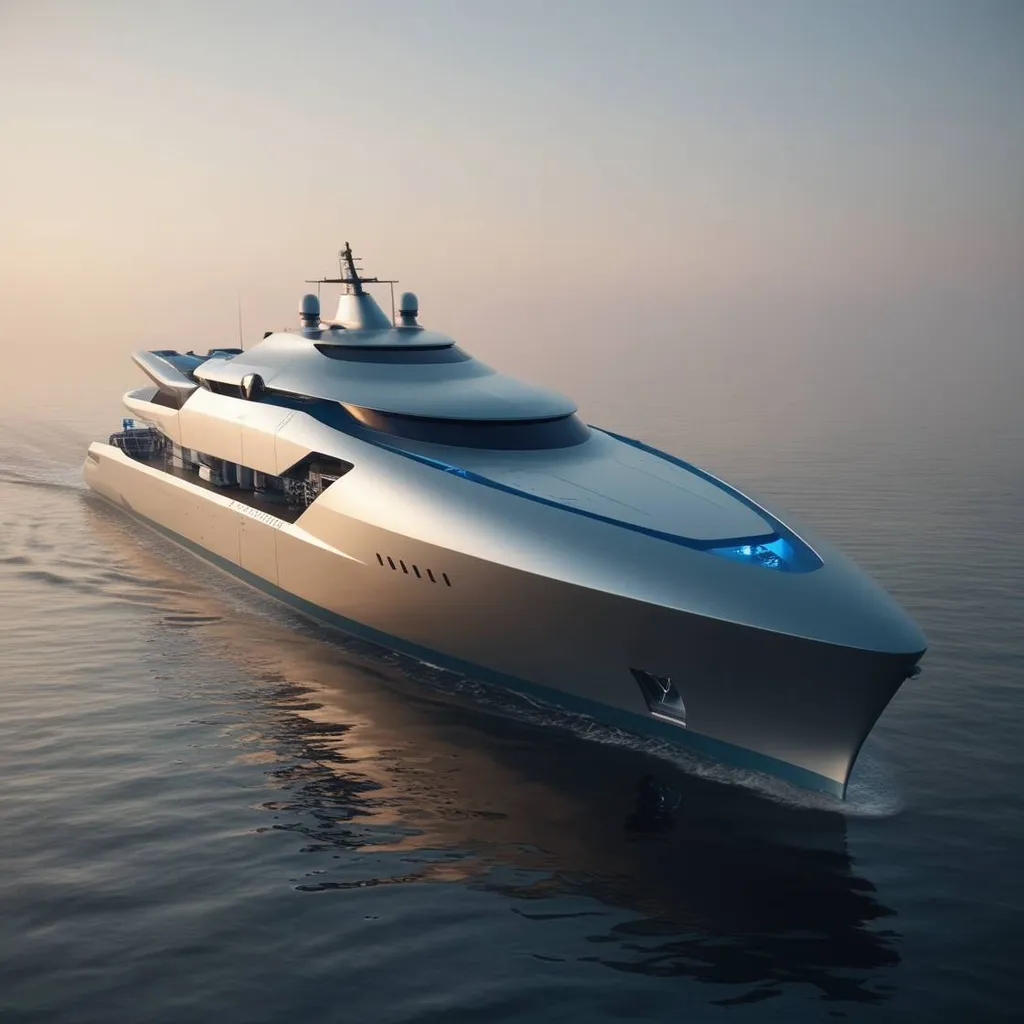
Researchers at Extrality, including Jocelyn Ahmed Mazari, Antoine Reverberi, Pierre Yser, and Sebastian Sigmund, have introduced a groundbreaking framework designed to revolutionize the ship design process. Their work, titled “Multi-Objective Hull Form Optimization with CAD Engine-based Deep Learning Physics for 3D Flow Prediction,” focuses on optimizing the hull forms of container vessels using advanced deep learning and computational fluid dynamics (CFD) techniques.
The study introduces the Deep Learning Physics Optimization (DLPO) framework, which integrates Extrality’s Deep Learning Physics (DLP) model with a CAD engine and an optimizer. This integration allows for the automatic evaluation of design iterations in an end-to-end manner, significantly accelerating the ship design process. The DLP model is trained on full 3D volume data derived from Reynolds-Averaged Navier-Stokes (RANS) simulations, enabling it to provide accurate and high-quality 3D flow predictions in real-time.
The researchers applied the DLPO framework to the Duisburg Test Case (DTC) container vessel, demonstrating its capabilities through two key applications. First, they conducted a sensitivity analysis to identify the most promising generic basis hull shapes. Second, they performed a multi-objective optimization to quantify the trade-offs between different optimal hull forms. The framework’s ability to evaluate design iterations quickly—each taking only 20 seconds—results in substantial time and engineering effort savings. This efficiency provides valuable insights into vessel performance, including detailed flow information akin to RANS simulations.
One of the standout achievements of the DLP model is its ability to recover the forces acting on the vessel by integrating data on the hull surface with a mean relative error of 3.84% ± 2.179% on the total resistance. This high accuracy makes the DLPO framework a powerful tool for optimizing new container vessel designs with respect to hydrodynamic efficiency.
The practical applications of this research are immense for the maritime industry. By accelerating the design process and enhancing the accuracy of hydrodynamic predictions, the DLPO framework can lead to the development of more efficient ships with superior performance. This innovation not only reduces the time and resources required for ship design but also paves the way for more sustainable and cost-effective maritime operations.
In conclusion, the DLPO framework represents a significant advancement in the field of ship design. Its integration of deep learning and physics-based modeling offers a robust solution for optimizing hull forms, ultimately contributing to the creation of more efficient and environmentally friendly vessels. The researchers’ work underscores the potential of AI and machine learning to transform traditional engineering processes, setting a new standard for innovation in the maritime sector. Read the original research paper here.