
In the vast, chilly expanses of the Tibetan Plateau, a silent battle is raging. Permafrost, the frozen ground that’s been locked in ice for millennia, is under siege from climate change. But it’s not just the heat that’s causing problems; it’s also the sand. Aeolian sand cover, to be precise. This is the focus of a recent study published in the journal ‘Geoderma’, which translates to ‘Soil Science’. The lead author, Tianli Lan from the State Key Laboratory of Subtropical Building and Urban Science at South China University of Technology, has been delving into the complex interplay between sand, climate, and permafrost.
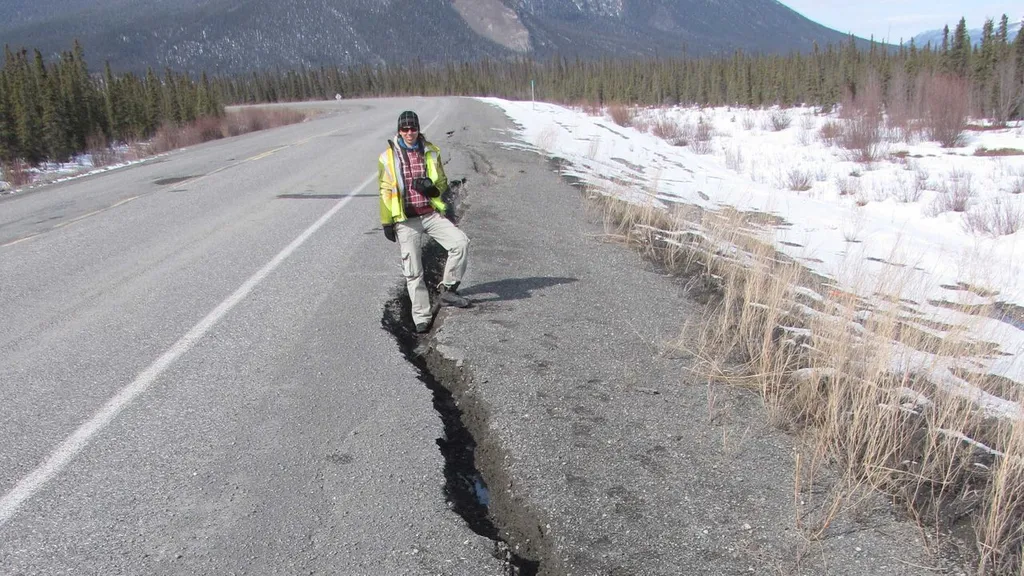
So, what’s the big deal? Well, for starters, permafrost degradation can wreak havoc on infrastructure. Roads, buildings, and pipelines can buckle and crack as the ground beneath them thaws and shifts. This is a significant concern for maritime professionals, especially those involved in port construction and maintenance in Arctic regions. Understanding the mechanisms at play can help in designing more resilient infrastructure.
Lan and his team found that the thickness of the sand cover plays a crucial role in how permafrost responds to climate change. Under a thin layer of sand, heat conduction is the main driver. Climate warming increases surface heat flux, accelerating permafrost degradation. “Under thin ASC, infiltration is tiny and heat conduction dominates heat transfer,” Lan explains. But when the sand cover is thick, infiltration and heat convection become significant. Climate warming increases annual infiltration, driving a decrease in latent heat of evaporation and further promoting permafrost degradation.
The study also found that increased precipitation has differing effects based on the thickness of the sand cover. Under thin sand cover, it cools the permafrost by enhancing evaporation and reducing surface heat flux. But under thick sand cover, it warms the permafrost by suppressing evaporation increment and enhancing both surface heat flux and subsurface heat convection.
For the maritime sector, these findings could open up new opportunities. For instance, understanding these processes could aid in the development of more accurate climate models, which are crucial for predicting sea level rise and changes in ocean currents. Moreover, the insights gained could inform the design of more sustainable and resilient port infrastructure in Arctic regions.
In the words of Lan, “As precipitation increases, thin ASC cools the permafrost by enhancing evaporation and reducing surface heat flux. In contrast, thick ASC warms the permafrost by suppressing evaporation increment and enhancing both surface heat flux and subsurface heat convection.” This nuanced understanding of the interplay between sand, climate, and permafrost is a significant step forward in our quest to mitigate the impacts of climate change. And for maritime professionals, it’s a reminder that the fight against climate change is not just about reducing emissions; it’s also about understanding and adapting to the changes that are already underway.