
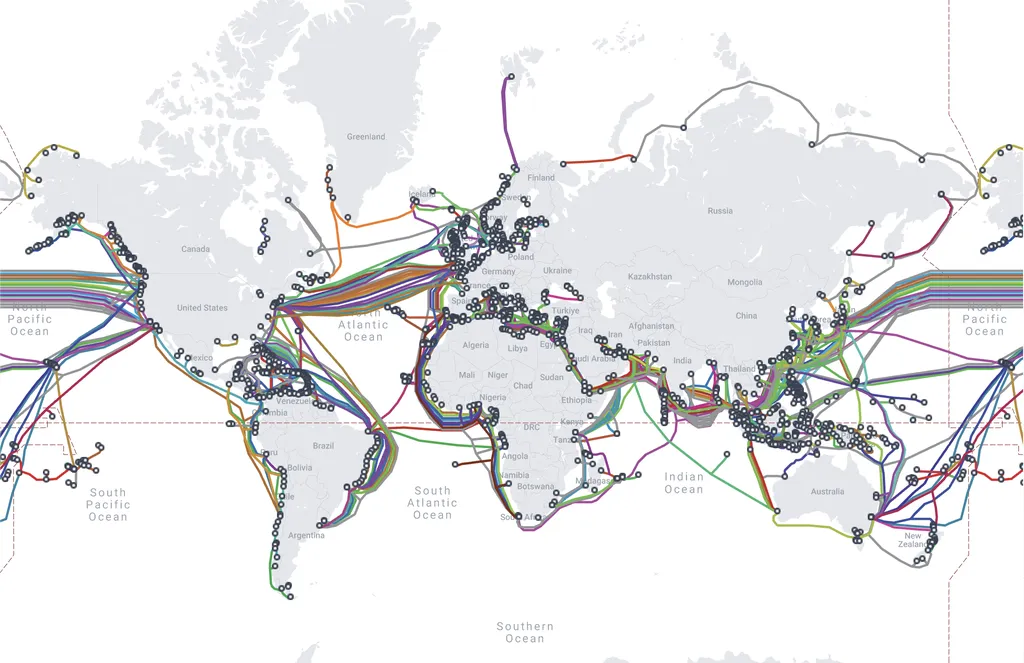
A new study, led by a team of researchers from the UAE, Canada, Japan, and Taiwan, is shedding light on a critical yet often overlooked issue: the security of underwater communication cables. The study, which collates a range of statistics and expert opinions, aims to address an urgent puzzle: Where and under what conditions do states prioritize cable security?
The researchers focused on three contrasting cable systems: the Unity/EAC Pacific (Japan–U.S.), the Asia-America Gateway (Guam–Hawaii), and the Tata TGN-Tata Indicom (India–Singapore). Their findings reveal that the risk to such cables varies predictably with geopolitical tension, peaking during ambiguous periods between peace and overt conflict. During these times, adversaries exploit unclear attribution and uncertain response thresholds to employ “gray zone” actions such as sabotage that disrupt but don’t trigger direct retaliation.
Cable landing sites, for instance, present likely targets for sabotage due to their accessibility on land. However, some experts believed that they only become more vulnerable during wartime when states no longer seek plausible deniability. The study also found that territorial seas and Exclusive Economic Zones (EEZs) are more vulnerable than the high seas, because sabotage is easier in shallow waters and on wide continental shelves. However, some experts emphasized proximity to the saboteur and the level of tension rather than bathymetric considerations.
One interviewee succinctly captured the dynamic nature of this risk, stating: “As geopolitical tensions rise, your appetite for risk also goes up.” The aim of the saboteur is also important. In a time of medium tension between states, the aim would be to create uncertainty and frustration in a target state. In wartime, sabotage would be more targeted towards disrupting communications.
The results of the study reveal patterned heterogeneity rather than uniform vulnerability. Landing stations matter, but not equally; some cable systems are systematically riskier than others; legal maritime zones do not reliably predict exposure; and gray-zone phases between peace and war emerge as especially dangerous windows for selective sabotage.
“This study underscores the need for a nuanced understanding of cable security,” says lead researcher Brendon J. Cannon. “It’s not just about protecting every cable equally. We need to adopt a tiered, scenario-based security posture that prioritizes protection at the segment/system level.”
The researchers propose a six-point policy framework to enhance cable security. This includes strengthening early warning systems for gray zone risks, conducting operationally focused vulnerability assessments, developing regional seas frameworks to pool assets, and ensuring national readiness through audits, single points of contact, and codified public–private protocols.
This study is a wake-up call for policymakers and industry stakeholders. It highlights the need for a more strategic and coordinated approach to cable security, one that recognizes the complex interplay of geopolitical tensions, technological vulnerabilities, and operational realities. As our reliance on underwater communication cables continues to grow, so too must our commitment to protecting them.