
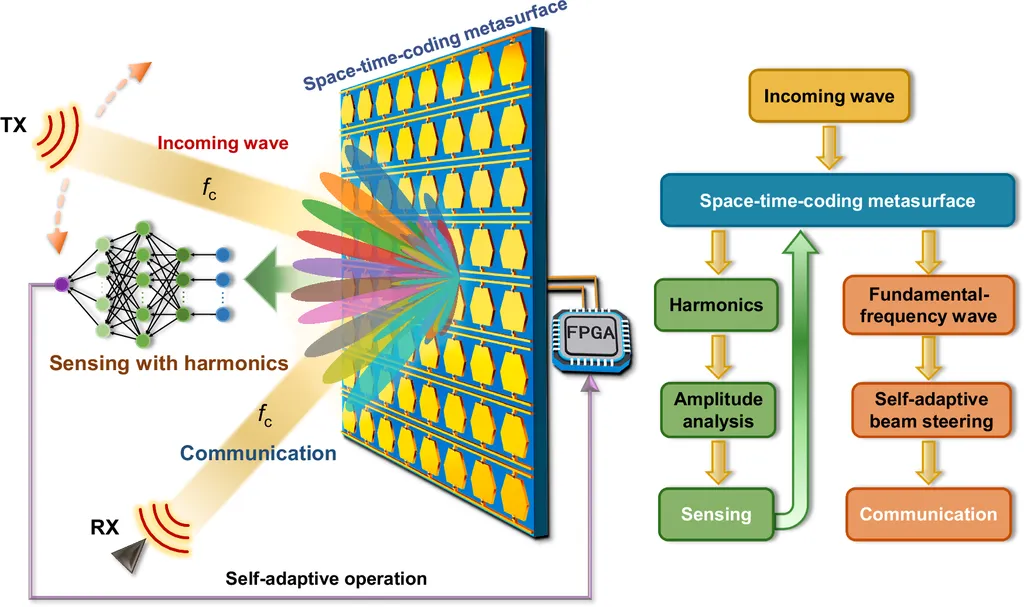
In a significant stride towards enhancing wireless communication efficiency, researchers have developed a novel framework that could revolutionize how maritime sectors manage data transmission and energy consumption. The Hierarchical Intelligent Deep Reinforcement Learning with Integrated Sensing and Communication (HIDRL-ISAC) framework, proposed by Ammar Summaq from the Department of Electronics and Communication Engineering at SRM University-AP, India, offers a robust solution for optimizing energy efficiency in reconfigurable intelligent surface (RIS)-assisted wireless systems.
So, what does this mean for maritime professionals? Imagine a scenario where ships, offshore platforms, and coastal installations can communicate more efficiently, using less energy, and adapting in real-time to changing conditions. The HIDRL-ISAC framework achieves this by employing dual agents: a master agent that optimizes beamforming and phase shifting, and a slave agent that adjusts transmit power based on user location feedback. This dynamic approach addresses the challenges of non-convexity and temporal variability, making it particularly suitable for the maritime environment where conditions can change rapidly.
The framework leverages an Extended Kalman Filter (EKF) for robust position tracking, ensuring that the system can accurately monitor and respond to the mobility of users. This is crucial for maritime applications where vessels and equipment are constantly on the move. As Summaq explains, “HIDRL-ISAC effectively addresses the non-convexity and temporal variability of the optimization problem by adapting to channel fluctuations and mobility patterns in real time.”
The commercial impacts of this technology are substantial. Energy efficiency is a critical concern for maritime operations, where power consumption directly affects operational costs. By optimizing energy use, the HIDRL-ISAC framework can help reduce these costs, making maritime communications more sustainable and economically viable. Additionally, the improved spectral efficiency can enhance data transmission rates, enabling better coordination and communication between vessels and shore-based operations.
The simulation results presented in the study, published in the IEEE Access journal (which translates to “IEEE Open Access”), demonstrated significant improvements in energy efficiency and convergence. This establishes HIDRL-ISAC as a resilient and scalable solution for mobility-aware RIS-assisted wireless systems, paving the way for its application in various maritime scenarios.
For maritime professionals, the adoption of this technology could mean more reliable and efficient communication systems, reduced energy costs, and improved operational efficiency. As the maritime industry continues to evolve, the integration of advanced wireless technologies like HIDRL-ISAC will be crucial in meeting the demands of modern maritime operations.