
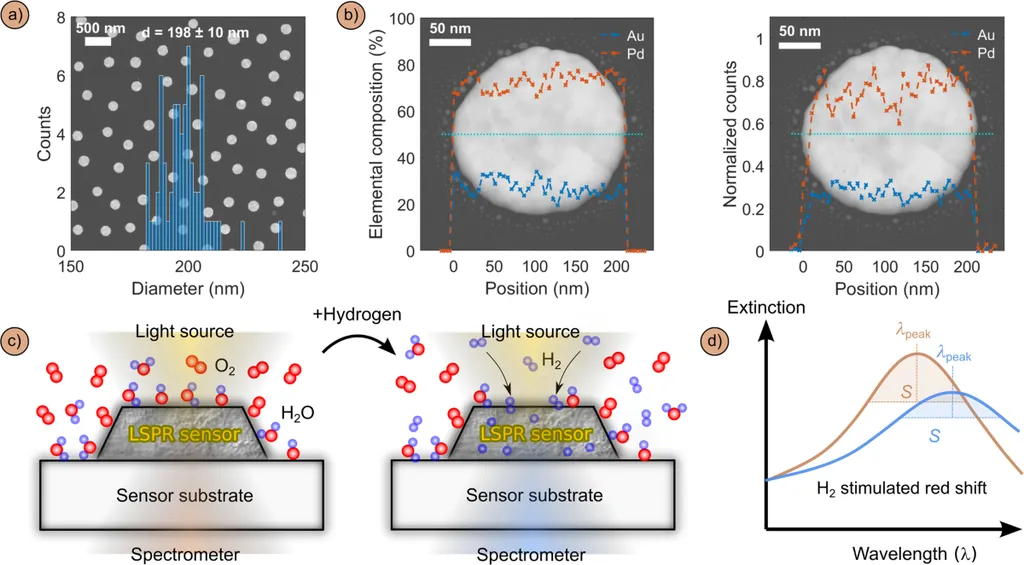
In a significant stride towards enhancing hydrogen safety monitoring, researchers have developed a novel optical hydrogen sensor that leverages the power of surface plasmon resonance. This innovation, spearheaded by Xuhui Zhang from the Liaoning Key Laboratory of Marine Sensing and Intelligent Detection at Dalian Maritime University, addresses the limitations of traditional palladium film sensors, which often suffer from weak responses and susceptibility to interference.
The new sensor design is a game-changer, utilizing a periodic palladium nanopore array structure combined with a low refractive index magnesium fluoride substrate. This combination results in a remarkable redshift in the reflection spectrum after hydrogen adsorption and an increase in reflectivity. According to the study published in ‘Scientific Reports’ (which translates to ‘Scientific Reports’ in English), this design boasts a sensitivity superior to that of traditional planar palladium films.
So, what does this mean for the maritime industry? Hydrogen is increasingly being considered as a clean energy source for maritime applications, from fuel cells in ships to hydrogen-powered ports. However, hydrogen’s flammability and explosivity pose significant safety challenges. High-performance hydrogen sensors are crucial for monitoring hydrogen leaks and ensuring safety in these environments.
The nanopore array in this new sensor enhances the optical response through local field enhancement and surface lattice resonance coupling. The magnesium fluoride substrate, with its low optical loss and excellent light transmittance, further optimizes the plasmon resonance performance. As Xuhui Zhang explains, “This study provides a new approach for the development of highly sensitive, fast-response, and intrinsically safe hydrogen sensors.”
The commercial implications are substantial. High-performance hydrogen sensors can lead to improved safety measures, reduced risk of accidents, and increased confidence in hydrogen-based technologies. This could accelerate the adoption of hydrogen as a marine fuel, contributing to the decarbonization of the maritime industry.
Moreover, the development of such advanced sensors opens up opportunities for innovation in other areas of maritime safety and monitoring. The principles behind this sensor could be adapted for detecting other gases or substances, further enhancing safety in maritime operations.
In conclusion, this research represents a significant step forward in hydrogen safety monitoring, with profound implications for the maritime industry. As the world looks towards cleaner energy solutions, innovations like this one will be crucial in ensuring safety and facilitating the transition to a more sustainable future.