
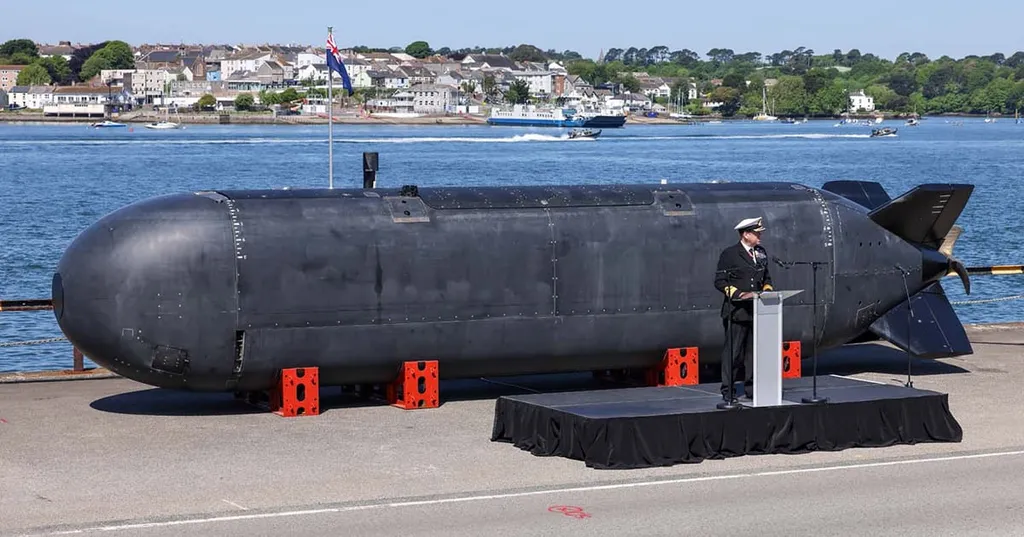
The Royal Navy has taken a bold step into the future of underwater warfare with the unveiling of its first uncrewed submarine, Excalibur. This 12-meter-long, 19-tonne vessel, developed under Project Cetus, is the largest uncrewed underwater vehicle ever trialed by the Royal Navy. The ceremony at HMNB Devonport, attended by Rear Admiral James Parkin and representatives from AUKUS nations, marked a significant milestone in the Navy’s journey towards autonomy and advanced underwater capabilities.
Excalibur, built by Plymouth-based MSubs, will undergo extensive sea trials over the next two years. These trials are crucial for understanding the unique challenges of operating large uncrewed vessels and for developing future vessels designed to work alongside crewed platforms. The insights gained will contribute to the Royal Navy’s efforts to stay ahead of potential adversaries, protect critical infrastructure, and gather intelligence.
Commodore Marcus Rose, deputy director of Underwater Battlespace Capability, emphasized the importance of these trials: “The naming of Excalibur is a significant milestone for the Royal Navy and the upcoming sea trials will allow us to rapidly develop our understanding of operating uncrewed vessels of this size underwater. The lessons learnt from this exciting programme will build on our experience from existing programmes, such as the Mine Hunting Capability programme, to inform more extensive use of these technologies in a mixed force of crewed and uncrewed systems. Successful delivery of this programme is testament to what can be achieved in collaboration with our industrial partners.”
Excalibur, classified as an Extra-Large Uncrewed Underwater Vessel (XLUUV), will join the Fleet Experimentation Squadron under the Disruptive Capabilities and Technologies Office. It will serve as a testbed for cutting-edge maritime technology, leveraging its Intelligence Surveillance and Reconnaissance (ISR) capabilities, stealth, and ability to carry bespoke payloads. Although it won’t perform operational duties, Excalibur will shape future concepts and strategies for uncrewed underwater operations.
Rear Admiral Parkin added, “This is an exciting day for the Royal Navy, the UK Armed Forces, and my team in particular as today marks the moment at which we take ownership of this superb vessel for the first time. In our journey towards autonomy and mass, it is vital we learn by doing, and Excalibur will be our mechanism for understanding the complexity and challenges of operating a future team of crewed and uncrewed vessel and systems underwater.”
The unveiling of Excalibur is more than just a technological achievement; it’s a strategic move that could redefine underwater warfare. As the Royal Navy integrates uncrewed systems into its operations, it sets a precedent for other navies and underscores the growing importance of autonomy in modern military strategy. The lessons learned from Excalibur’s trials will be invaluable, not just for the UK but for global maritime security.
This development also highlights the collaborative efforts between the military and private sector, with MSubs playing a pivotal role in bringing Excalibur to life. Such partnerships are essential for driving innovation and ensuring that military capabilities keep pace with technological advancements.
As Excalibur embarks on its sea trials, the eyes of the maritime world will be watching closely. The success of this project could pave the way for a new era of underwater operations, where uncrewed systems play a central role in safeguarding national interests and maintaining maritime dominance.