
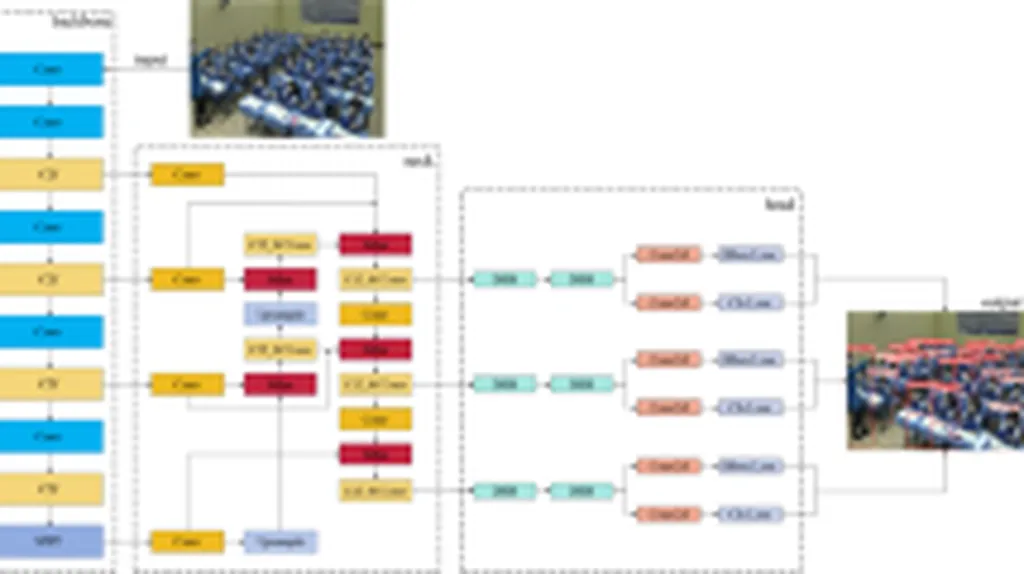
In the realm of smart classrooms, keeping tabs on student behavior is no easy feat. The scene is often a bustling, complex environment where students move around, interact, and sometimes, occlude each other from the view of cameras. This is where the work of Yanfei Li from the Jiangsu Maritime Institute comes into play. Li and their team have developed a lightweight, efficient object detection framework called YOLOv11n-SFS, specifically designed for embedded educational monitoring systems.
So, what’s the big deal about this framework? Well, it’s all about balancing accuracy, computational cost, and hardware efficiency. The team’s approach incorporates three key architectural enhancements. First, there’s StarNet, a parameter-efficient backbone that uses element-wise multiplication and depthwise separable convolutions. Then, there’s C3k2-Faster, an optimized neck module based on Partial Convolution for improved multi-scale feature fusion. Lastly, there’s SCLD, a compact detection head using Group Normalization and shared convolution to ensure stable performance under limited batch sizes.
In simpler terms, this framework is like a super-efficient teacher’s assistant. It can accurately detect and recognize student behaviors in real-time, even in complex scenes and with limited computational resources. This is particularly useful for edge devices, which are often resource-constrained.
The results speak for themselves. On a curated student behavior dataset, YOLOv11n-SFS achieved an impressive 95.68% mean Average Precision at 0.5 Intersection over Union ([email protected]) with only 1.63 million parameters and a model size of 3.4 MB. It also delivered 35.66 frames per second (FPS) on CPU inference.
Now, you might be wondering, what does this have to do with the maritime sector? Well, the principles of lightweight, efficient object detection can be applied to various maritime applications. For instance, it could be used for real-time monitoring of crew activities on ships, or for detecting and recognizing objects or behaviors in port environments. The framework’s ability to perform well on resource-constrained devices makes it particularly suitable for maritime environments, where computational resources might be limited.
As Li puts it, “The model demonstrates strong deployment potential in practical classroom systems, offering a practical balance between accuracy, computational cost, and hardware efficiency for embedded AI applications in educational environments.” This balance is equally valuable in maritime settings, where efficiency and reliability are paramount.
The research was recently published in ‘Discover Applied Sciences’, a journal that focuses on the application of scientific knowledge to solve real-world problems. This work is a testament to how AI can be leveraged to create smarter, more efficient environments, whether it’s in classrooms or on the high seas.