
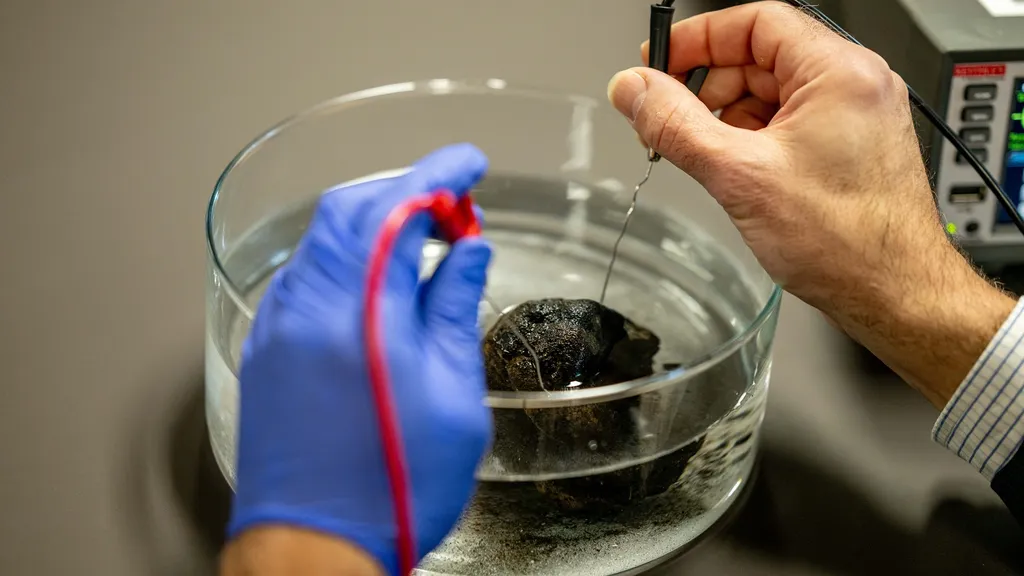
The ocean’s abyss, a realm of crushing pressure and perpetual darkness, has long been a frontier of mystery and discovery. Now, a groundbreaking research initiative is poised to unravel one of its most perplexing enigmas: the origins of “Dark Oxygen.” This phenomenon, first identified by Professor Andrew Sweetman of the Scottish Association for Marine Science (SAMS) in 2024, challenges the fundamental scientific understanding that oxygen production is solely reliant on sunlight through processes like photosynthesis.
The discovery of oxygen-producing metallic nodules in the deep sea has sent ripples through the scientific community. These nodules, rich in highly sought-after metals, could revolutionize our understanding of how life is distributed in the ocean’s deepest trenches. But the mechanism behind this oxygen production remains shrouded in mystery. Enter The Nippon Foundation – Dark Oxygen Research Initiative (DORI), a collaborative effort led by Professor Sweetman, geobiologist Professor Jeffrey Marlow from Boston University, and chemist Professor Franz M Geiger of Northwestern University. Their mission: to uncover the secrets of Dark Oxygen.
To tackle this mystery, the DORI team has designed two state-of-the-art landers, Alisa and Kaia, named after Professor Sweetman’s daughters. These landers, capable of withstanding pressures 1,200 times greater than at Earth’s surface, are equipped to delve into the abyssal depths of the Clarion Clipperton Zone (CCZ) in the central Pacific Ocean. The landers will investigate whether the nodules spontaneously interact with saltwater to generate electricity, if a biochemical process is at work, or if another, yet unknown factor is involved.
The Nippon Foundation’s funding has made this ambitious project possible, covering the construction of these world-first landers. Scheduled for deployment in the spring, Alisa and Kaia will collect water samples, take precise measurements from the nodules, introduce chemical tracers, and analyze the presence of protons linked to water oxidation. This data will be crucial in differentiating between electrolysis and other potential oxygen-generating mechanisms.
Accompanying Alisa and Kaia will be an Aquatic Eddy Covariance (AEC) lander, designed to measure the flux of oxygen in the area. This will help identify any patterns in oxygen production and determine if other environmental factors are at play. The initial results from this pioneering research are expected later this year, with the project endorsed by IOC UNESCO as part of the UN Ocean Decade activities.
Professor Sweetman’s initial discovery has already challenged the prevailing scientific consensus, and the findings from this research could redefine our understanding of deep-sea ecosystems. “This project is a game-changer,” says Professor Sweetman. “It’s not just about answering one of the ocean’s deepest mysteries; it’s about reimagining the very foundations of life in the abyss.”
Professor Marlow adds, “The potential implications are vast. If we can understand how these nodules produce oxygen, it could open up new avenues for exploring life in extreme environments, both on Earth and potentially on other planets.”
Professor Geiger emphasizes the interdisciplinary nature of the project: “This is a perfect example of how collaboration across different scientific fields can lead to breakthroughs. By combining our expertise in geobiology, chemistry, and marine science, we’re pushing the boundaries of what we know about our planet.”
As Alisa and Kaia embark on their mission into the ocean’s darkest depths, the scientific community watches with bated breath. The answers they uncover could not only solve the puzzle of Dark Oxygen but also illuminate the broader mysteries of life in the deep sea. This research is a testament to human curiosity and ingenuity, proving that even in the most extreme and inhospitable environments, there are still wonders waiting to be discovered.