
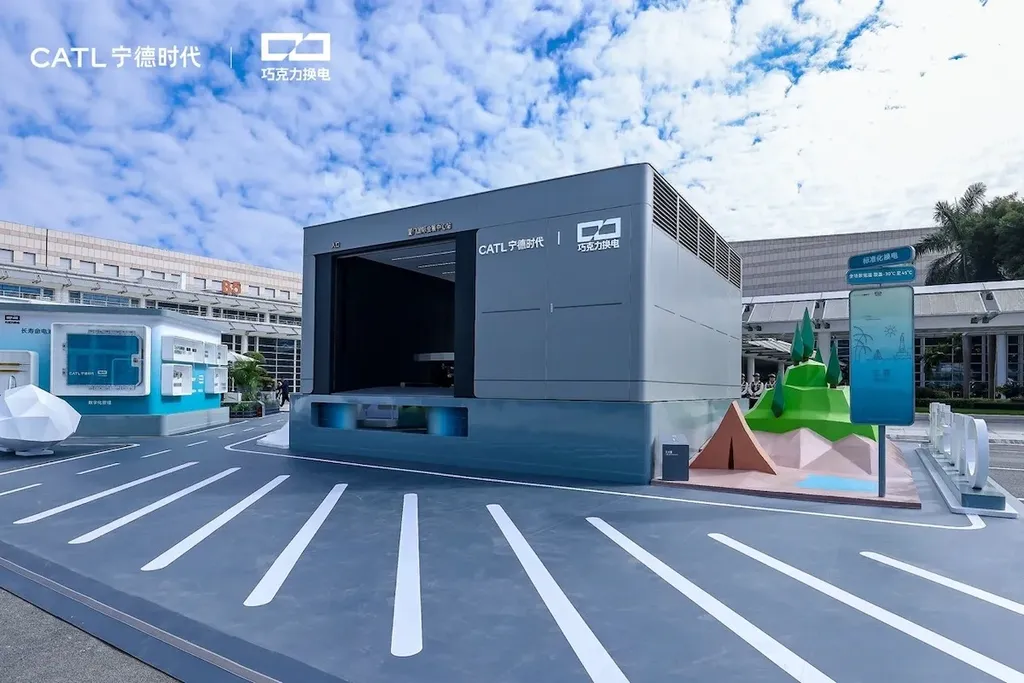
In a significant stride towards greening automated container terminals, a recent study published in ‘Frontiers in Marine Science’ tackles the dual challenges of high capital investment and demand uncertainty in battery swapping stations (BSSs) for electric automated guided vehicles (AGVs). The research, led by Xingchun Li, proposes a novel approach to optimize battery investment and replacement strategies, ensuring a cost-effective transition to green logistics.
The study addresses a critical gap in current practices. Traditional replacement strategies, often based on fixed cycles or empirical judgment, fail to account for battery performance degradation and demand fluctuations. This can lead to resource mismatches, hindering the economic sustainability of electrification. As Li puts it, “Traditional replacement strategies often fall short, leading to resource mismatches and economic inefficiencies.”
The proposed multi-period decision-making model manages batteries in age-based groups, optimizing procurement timing and usage allocation to minimize total operational cost in net present value. To handle demand uncertainty without relying on precise distributional information, the researchers established distributionally robust chance constraints based on the Wasserstein distance. They also proposed an approximation method using Conditional Value-at-Risk (CVaR) and derived its closed-form expression through duality theory.
The commercial impacts of this research are substantial. For maritime professionals, the study offers a robust framework for reliable and resilient energy management in decarbonized terminals. It provides a theoretical foundation for optimizing battery investment and replacement strategies, ensuring cost-effectiveness and economic sustainability.
The study’s findings are particularly relevant for automated container terminals, where AGV battery swapping stations are becoming increasingly prevalent. By adopting the proposed model, terminal operators can enhance their operational efficiency, reduce costs, and contribute to the decarbonization of the maritime industry.
In a comparative analysis, the CVaR method exhibited superior robustness in extreme demand scenarios compared to expectation-based approaches. This highlights the model’s potential to provide reliable energy management solutions, even in the face of significant demand fluctuations.
As the maritime industry accelerates its transition towards decarbonization, this research offers valuable insights and practical tools for optimizing battery investment and replacement strategies. By embracing these findings, maritime professionals can drive the industry towards a more sustainable and economically viable future.
The study, titled “Distributionally robust battery investment and replacement for AGV battery swapping stations with demand uncertainty in automated container terminals,” was published in ‘Frontiers in Marine Science’, which translates to ‘Frontiers in Marine Science’ in English. This research is a significant step forward in the quest for green logistics, offering a robust and reliable framework for energy management in automated container terminals.