
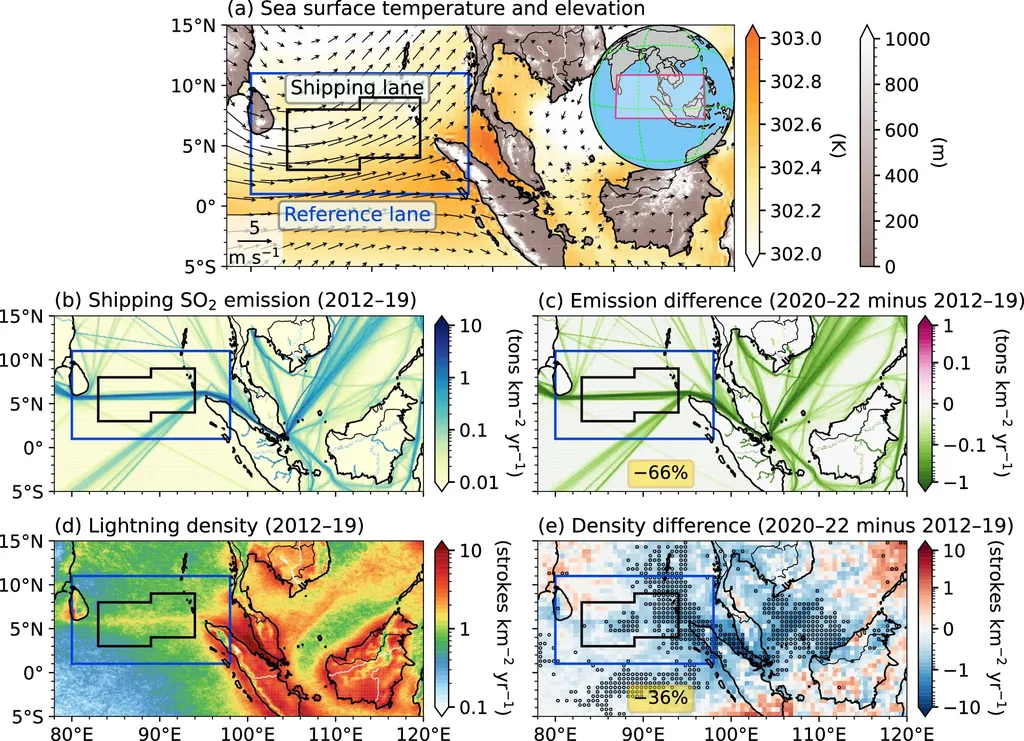
New research from the University of Kansas (KU) has uncovered an unexpected side effect of the International Maritime Organization’s (IMO) 2020 sulfur cap on shipping fuel: a reduction in lightning stroke density along major shipping routes. The study, led by Qinjian Jin, assistant teaching professor of geography & atmospheric science at KU, highlights a fascinating interplay between maritime emissions and atmospheric phenomena.
The research focused on heavily trafficked routes in the Bay of Bengal and the South China Sea, where lightning activity had been notably frequent before the IMO’s regulations. The implementation of the sulfur cap led to a roughly 70% drop in sulfate emissions in these regions. Jin and his team observed a 36% decrease in lightning-stroke density following the reduction in sulfur emissions from ships.
“I think there are two reasons for this,” Jin explained. “The first is the shipping activity is so frequent that it releases a lot of sulfate aerosols, more than other oceanic regions. The second is that the Bay of Bengal is an area where we see lots of strong convection that is required for lightning to occur. I think both reasons contribute to the observed frequent lightning activity over this region.”
Sulfate aerosols play a crucial role in cloud formation and lightning activity. These particles, whether emitted naturally or through human activities, influence cloud microphysical properties. “When we have more sulfate aerosols, or more cloud nuclei, the cloud droplets become smaller,” Jin said. “When they’re smaller, it’s harder for precipitation to occur. Clouds can last longer in the atmosphere. With a longer lifetime, they have a higher chance to develop into high clouds, where ice clouds form. When we have more ice clouds, we have a higher chance of lightning. That is how sulfate aerosols can be connected to lightning.”
The reduction in lightning strokes detected along busy shipping routes can be attributed to the decrease in sulfate aerosols, which leads to fewer cloud condensation nuclei. This, in turn, results in larger cloud drops, weaker convection and storms, and ultimately fewer ice crystals and less frequent lightning.
While the primary goal of the 2020 IMO regulations was to improve air quality, the reduction in lightning can be seen as an additional benefit. Lightning poses risks to mariners, equipment, and operations at sea, making its decrease a welcome side effect.
However, Jin cautioned that the reduction in sulfur emissions might have another consequence: warmer global temperatures. “Due to the 2020 emission regulation imposed by the International Maritime Organization, we observed a decrease in sulfur emissions from ships after 2020,” he said. “With less sulfate aerosol emitted from ships, we observed darker clouds over the North Atlantic Ocean and the Pacific Ocean. Because clouds become darker, they absorb more solar radiation. Our previous studies imply that the decrease in shipping sulfate aerosols could be responsible for the record-breaking global warming temperatures in 2023 and 2024.”
Jin’s future research aims to better understand this potential effect, highlighting the complex and interconnected nature of environmental regulations and their broader impacts.
The lightning data used in the study come from the World Wide Lightning Location Network, produced by the University of Washington. This research underscores the importance of continuous monitoring and adaptive policy-making in the maritime industry, as actions taken to address one environmental concern can have far-reaching and sometimes unexpected consequences.