
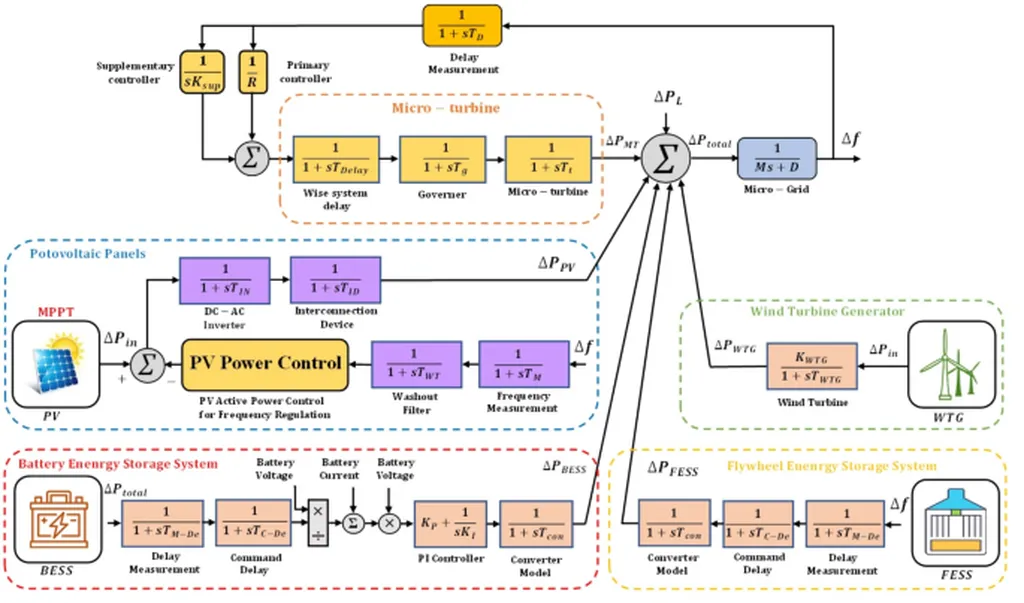
In the world of maritime and offshore operations, power stability is paramount. A recent study published in the *International Journal of Electrical Power & Energy Systems* (which, in plain English, is a journal focused on electrical power and energy systems) tackles a critical issue for microgrids—those small-scale power grids that can operate independently. The research, led by Danyang Xu from the State Key Laboratory of Smart Power Distribution Equipment and System at Tianjin University in China, proposes a new way to keep frequencies stable in low-inertia microgrids after unexpected islanding events.
So, what’s the big deal? Well, imagine a ship or an offshore platform suddenly losing connection to the main power grid. That’s an unintentional islanding event (UIE). When this happens, the frequency of the power supply can fluctuate, potentially causing equipment malfunctions or even failures. Xu’s research aims to prevent this by developing a scheduling model that ensures frequency stays within safe limits—between 49.5 and 50.5 Hz—even after a UIE.
The study introduces a few key innovations. First, it approximates the post-UIE frequency dynamics using a quadratic function, which allows for a more straightforward analysis of how different resources can contribute to stabilizing the frequency. Second, it introduces the concept of an “equivalent enforcement condition” for the maximum frequency deviation constraint, which helps guide the scheduling of frequency support resources. To tackle the complexity of the problem, the researchers use a convex relaxation technique and an iterative algorithm to minimize the relaxation gap. Additionally, they incorporate a distributionally robust chance-constrained (DRCC) approach to account for the uncertainty of renewable energy sources, which are increasingly being integrated into microgrids.
For maritime professionals, the implications are significant. Ships and offshore platforms often rely on microgrids to power their operations. Ensuring that these microgrids can seamlessly handle islanding events without frequency instability can enhance the reliability and safety of maritime operations. This is particularly important as the maritime industry increasingly adopts renewable energy sources, which can introduce additional variability into the power supply.
“Building on these two approximations, an equivalent enforcement condition of the MFD constraint is derived,” Xu explains. This means that the scheduling model can effectively manage the frequency response, ensuring that the microgrid remains stable even after an unexpected islanding event.
The study’s findings were verified through numerical studies on a modified IEEE 33-bus microgrid, demonstrating the effectiveness of the proposed scheduling model. For the maritime sector, this research opens up opportunities to enhance the resilience of power systems on ships and offshore platforms, ultimately leading to more reliable and safer operations.
In summary, Xu’s research provides a robust framework for maintaining frequency stability in low-inertia microgrids, which is crucial for the maritime industry as it navigates the challenges of integrating renewable energy sources and ensuring seamless islanding capabilities. As the industry continues to evolve, such advancements will be key to maintaining the reliability and safety of maritime power systems.