
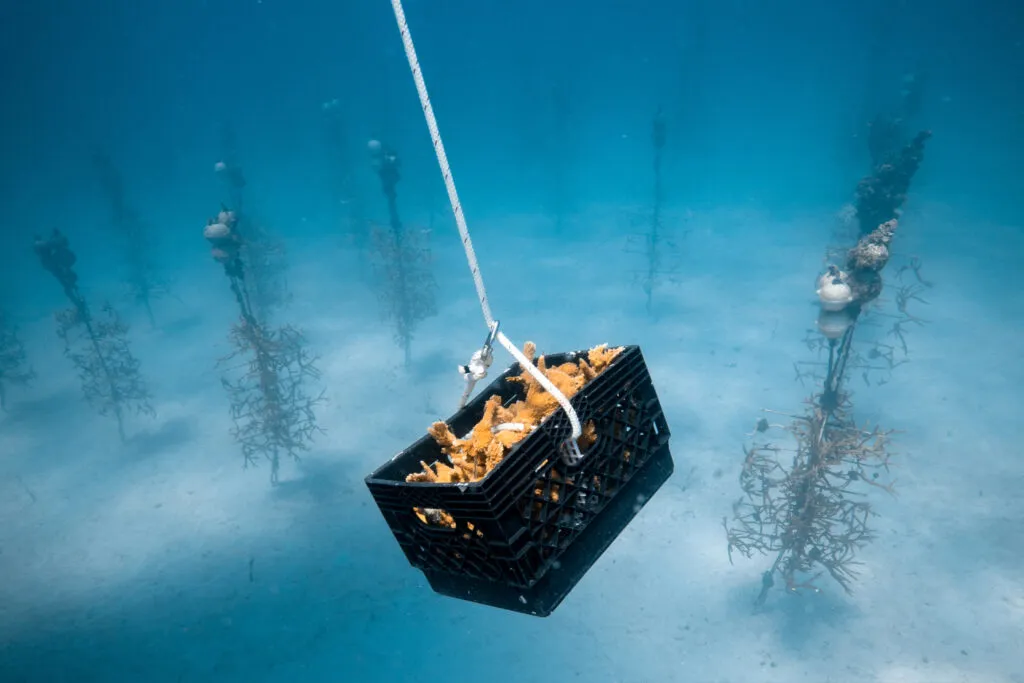
Will 2026 be the year when coral reefs pass their tipping point? Samantha Garrard, Senior Marine Ecosystem Services Researcher at Plymouth Marine Laboratory, asked the question in The Conversation on January 5. “Tropical coral reefs cover less than 1% of the seafloor, yet support 25% of all marine species. They are also incredibly vulnerable. Over the past few decades, an estimated 30%-50% have already been lost,” she said. Garrard concludes: “To help these biodiversity powerhouses survive the 21st century, we must do three things: aggressively cut carbon emissions to cool the water, reduce local stressors like pollution or overfishing and incorporate selective breeding of heat-tolerant corals into restoration plans to improve resilience to heatwaves.”
The urgency of this call to action is underscored by ongoing research efforts. This week, it was announced that scientists from the University of Plymouth will carry out an assessment of the response and resilience of mesophotic coral ecosystems—coral reef communities found at depths of between 30m and 150m in tropical regions—to the temperature shifts predicted under future climate change. Over the next five years, the project will focus on these deeper coral reef communities in the Indian Ocean and employ survey technologies for in-situ measurements of biodiversity, health, and physical environmental parameters.
Advances in subsea robotics are helping scientists better understand and monitor the processes occurring in coral reefs. However, conventional conservation methods struggle to provide the necessary scale and frequency of monitoring data required to understand coral reefs, said UAE researchers in a paper published in November 2025. Their review explores the potential of Autonomous Underwater Vehicles (AUVs) for comprehensive coral reef monitoring, highlighting recent advances including combining passive acoustic mapping with visual habitat classification onboard AUVs to provide multi-modal coral reef surveys. Current AI and machine learning developments additionally enable real-time data analysis and improved imaging techniques.
Developments in autonomous systems, including the integration of AUVs with autonomous surface vehicles, offer exciting possibilities for multi-platform operations, they say, with recent technological advancements including centimeter-scale coral-monitoring robots that can access narrow coral reef crevices that are inaccessible to conventional larger AUVs. AUVs also play a crucial role in coral restoration, supporting precision larvae placement, habitat reconstruction, and large-scale reef rehabilitation. Advances in autonomous manipulation and coordinated swarm robotics will further enhance restoration efficiency.
The researchers call for more innovation and conclude: “Future research must address challenges in standardization, adaptive mission planning, and assessing the ecological impacts of AUV operations. By utilizing recent advances in artificial intelligence and robotics, AUVs can enable real-time, predictive, ecosystem-scale monitoring, which is an essential step toward preserving coral reefs for future generations.”
The scale of processes impacting coral reefs is larger than some might expect. While renowned as biodiversity hotspots, a study by Sydney University and Université Grenoble Alpes researchers considers their role over geological time. Research led by Associate Professor Tristan Salles combined plate-tectonic reconstructions, global surface processes, and climate simulations with ecological modelling to reconstruct shallow-water carbonate production back to the Triassic period. The work revealed that the Earth system flips between two distinct modes that determine the pace of climate recovery.
“Reefs didn’t just respond to climate change – they helped set the tempo of recovery,” said Salles. In one mode, when tropical shelves are extensive and reefs thrive, carbonate accumulates in shallow seas, reducing chemical exchange with the deep ocean. This weakens the biological pump—the process by which marine organisms draw down carbon—and slows the planet’s recovery from carbon shocks.
In the other mode, when reef space collapses due to tectonic or sea-level change, calcium and alkalinity build up in the ocean. Carbonate burial then shifts to the deep sea, stimulating nannoplankton productivity and accelerating climate recovery. The study therefore suggests reefs have been central to the planet’s ability to stabilize climate.
Modern reef systems are declining rapidly due to warming and ocean acidification. If this trajectory mirrors ancient episodes of reef collapse, carbonate burial may shift from shallow reefs to the deep ocean. In principle, this could help draw down atmospheric carbon. However, the very organisms that drive deep-sea carbonate burial—plankton and other calcifying species—are themselves increasingly threatened by acidifying oceans and continued CO₂ emissions. Any potential stabilizing effect would therefore come only after severe and irreversible ecological loss.
Salles said: “From our perspective on the past 250 million years, we know the Earth system will eventually recover from the massive carbon disruption we are now entering. But this recovery will not occur on human timescales. Our study shows that geological recovery requires thousands to hundreds of thousands of years.”
The stakes are high, and