
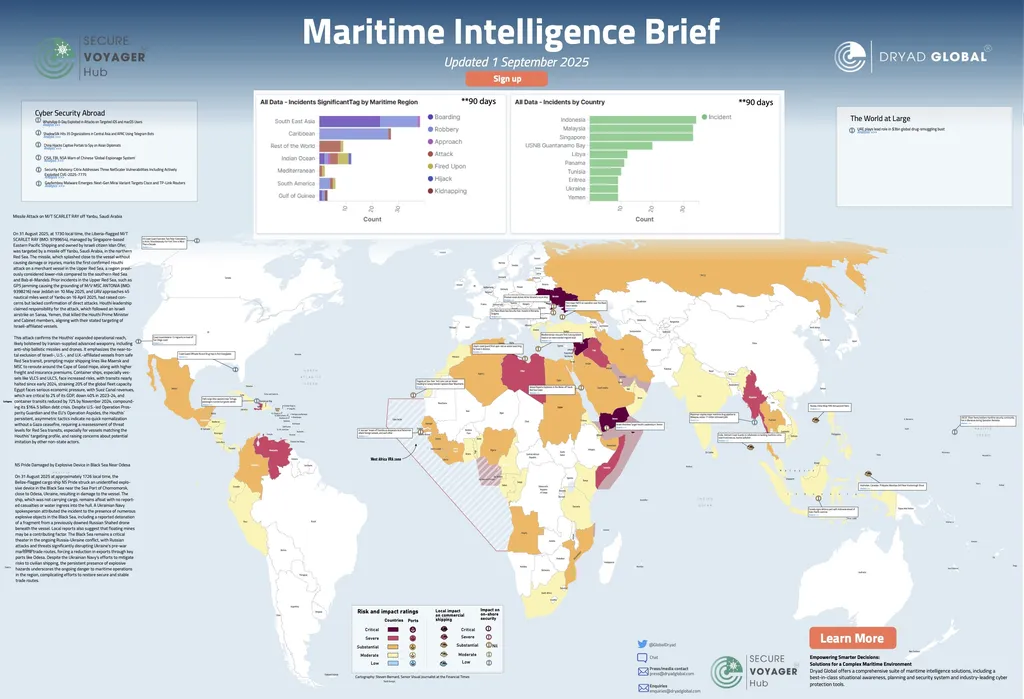
This week’s maritime security report from Palaemon Maritime pulls no punches: “Hello Shipmate, this week saw a sharp escalation in maritime security incidents across Europe, the Americas and Southeast Asia.” The latest developments paint a picture of a sector under siege, with attacks ranging from ballistic missile strikes to armed robberies. The escalation isn’t just in frequency—it’s in the audacity and sophistication of the threats.
In Ukraine, the Chornomorsk Port faced a ballistic missile attack, causing container damage and an oil spill. Meanwhile, Greek-managed oil tankers near the CPC terminal off Novorossiysk were hit by drone strikes, and a Panama-flagged vessel was struck by a Russian UAV, injuring one crew member. The Caspian Sea saw a cargo vessel sunk, though all 14 crew members were rescued. These incidents highlight the growing use of advanced weaponry in maritime conflicts, pushing the industry to rethink its security protocols.
Over in the Americas, U.S. forces seized a Guyana-flagged tanker near Venezuela as part of ongoing shadow-fleet enforcement. This move underscores the broader geopolitical tensions playing out at sea, where commercial vessels often find themselves caught in the crossfire. Armed robberies also made a comeback, with a bulk carrier boarded and engine spare parts stolen. A second attempt targeted a barge under tow in the eastbound TSS lane, showing that even routine operations are now fair game for opportunistic attacks.
The maritime security environment is evolving rapidly, and the January issue of Maritime Reporter magazine delves into how the industry is adapting. Dave Cudbertson, OCIMF Programs Director, highlights the flexibility of OCIMF’s new SIRE 2.0 Focused Inspection Campaign. This initiative is designed to strengthen vessel hardening processes, equipment, and procedures to better protect seafarers. Cudbertson’s insights underscore the importance of proactive measures in an era where threats are becoming more diverse and unpredictable.
For those looking to dive deeper into maritime security, the latest Maritime Matters: The MarineLink Podcast offers valuable perspectives. Seequent, the Bentley Subsurface Company, is at the forefront of helping organizations understand what’s happening under the seabed. Their tools are crucial for identifying and mitigating risks such as unexploded ordinance (UXO). Matt Grove, EMEA Regional Segment Manager – Offshore, and Becky Bodger, EMEA Customer Solutions Team Lead, discuss the array of tools available to tackle these challenges. Their expertise provides a glimpse into the technological innovations that are becoming indispensable in the fight to secure maritime operations.
The escalation in maritime security incidents is a wake-up call for the industry. It’s clear that traditional approaches to security are no longer sufficient. The use of advanced weaponry, such as drones and ballistic missiles, demands a re-evaluation of current strategies. The industry must embrace new technologies and methodologies to stay ahead of emerging threats. The insights from OCIMF and Seequent offer a roadmap for how this can be achieved, but the urgency of the situation cannot be overstated. The maritime sector must act swiftly and decisively to protect its assets and, most importantly, its people.