
In a significant stride towards smarter energy management, researchers have developed a novel deep learning model that could revolutionize short-term load forecasting, a critical aspect of integrating renewable energy sources into power grids. The study, led by Abid Ali from the School of Automation at Beijing Institute of Technology and the School of Electrical Engineering at Minhaj University, introduces a framework that not only predicts energy usage patterns but also explains its predictions, making it a game-changer for the maritime sector and other industries reliant on stable power supply.
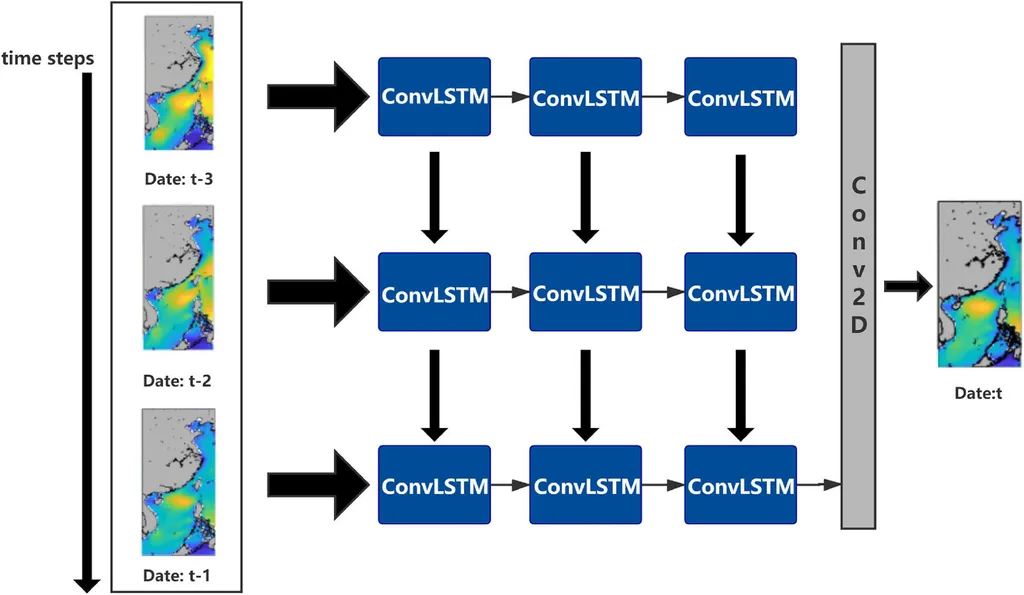
The model, dubbed XAE-ConvLSTM, combines an autoencoder to extract meaningful features from raw data, a deep learning framework based on convolutional and long short-term memory (LSTM) networks for automated forecasting, and an explainable AI component to interpret the predictions. This trifecta approach ensures accurate, reliable, and interpretable forecasts, which are crucial for managing intermittent renewable energy sources.
The results are impressive. When tested on datasets from the American Electric Power (AEP) and Panama, the model showed significant improvements in various performance metrics. For instance, it achieved a mean absolute error reduction of 189.80% in AEP and 28.22% in Panama, and a root mean squared error reduction of 254.01% in AEP and 38.60% in Panama. These improvements translate to more accurate predictions, which can lead to better decision-making and more efficient energy management.
So, what does this mean for the maritime sector? Well, ships and ports are increasingly relying on renewable energy sources and need accurate load forecasting to manage their power systems efficiently. As Abid Ali puts it, “This research enhances the existing knowledge on predicting and explaining peak load demand and has practical implications for creating intelligent energy management systems in smart grid applications.” With the XAE-ConvLSTM model, maritime professionals can expect more reliable power supply, reduced energy costs, and improved operational efficiency.
Moreover, the explainable AI component of the model is a significant advantage. It allows users to understand the factors contributing to the predictions, making it easier to trust and act on the model’s outputs. This transparency is particularly valuable in the maritime sector, where safety and reliability are paramount.
The study, published in the journal ‘Results in Engineering’ (translated from the original Chinese title), opens up new opportunities for the maritime sector and other industries to leverage advanced AI techniques for energy management. As we transition towards cleaner, greener power systems, such innovations will be crucial in ensuring a stable and sustainable energy future.