
In the ever-evolving world of maritime technology, a groundbreaking study led by Yuchao Hou from the Shanxi Key Laboratory of Cryptography and Data Security at Shanxi Normal University in Taiyuan, China, is making waves. The research, published in the IEEE Journal of Selected Topics in Applied Earth Observations and Remote Sensing, introduces a novel approach to synthetic aperture radar (SAR) image target recognition using federated learning (FL). This isn’t just another tech jargon-filled paper; it’s a practical solution to a real-world problem that could significantly impact the maritime sector.
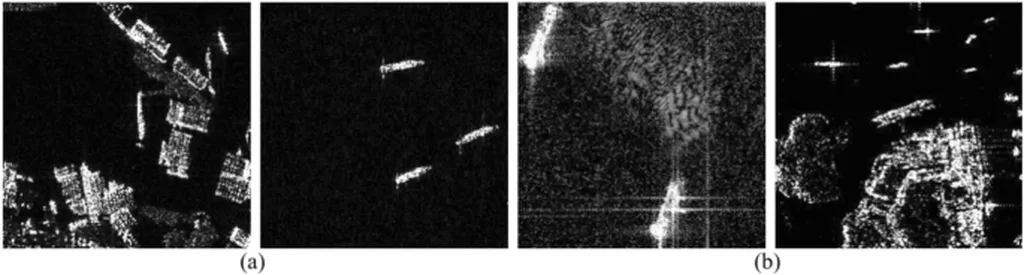
So, what’s the big deal? Well, imagine you’re a maritime professional relying on SAR images for various tasks, from navigation to surveillance. The images you receive come from different sensors, each with its unique characteristics. This heterogeneity can lead to inconsistencies and inaccuracies in target recognition, a problem that existing FL methods don’t fully address. They assume uniform differences in client data heterogeneity and overlook the inherent multilevel data heterogeneity of SAR images.
Enter FedC-DAC, a clustered FL framework designed to capture and utilize heterogeneity at multiple levels. It’s like a smart assistant that sorts through the data, groups similar sensors, enhances representation sharing, and reduces overfitting. As Hou explains, “FedC-DAC integrates Gaussian-mixture-model-guided soft grouping to reveal latent sensor similarities, introduces intracluster dynamic aggregation to enhance representation sharing while mitigating overfitting, and applies cross-cluster calibration to align feature distributions and reduce global inconsistency.”
The commercial impacts and opportunities for the maritime sector are substantial. Improved SAR image target recognition can enhance navigation safety, enable more accurate surveillance, and support better decision-making in various maritime operations. It’s not just about making things easier; it’s about making them safer and more efficient.
The study’s experimental results speak for themselves. FedC-DAC showed consistent gains over representative FL baselines in accuracy, Kappa, and F1 under strong heterogeneity. Moreover, its performance was close to centralized training when distributions were near uniform. This means that FedC-DAC can handle the complexities of real-world SAR data, providing reliable and accurate results.
In the words of Hou, “These results demonstrate improved robustness and generalization for distributed SAR recognition.” This is not just a leap in technology; it’s a step forward for the maritime industry. As we continue to explore and utilize the vast oceans, tools like FedC-DAC will be invaluable in navigating the challenges and opportunities that lie ahead.
So, whether you’re a maritime professional, a tech enthusiast, or just someone interested in the latest advancements, FedC-DAC is a development worth keeping an eye on. It’s a testament to the power of innovation and a promising step towards a safer and more efficient maritime future.