
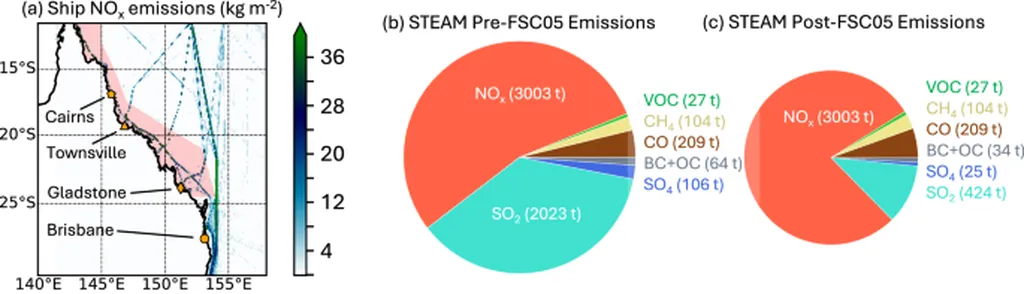
In a twist that’s got scientists and maritime professionals alike raising their eyebrows, new research suggests that well-intentioned shipping fuel regulations might be having an unintended impact on the Great Barrier Reef. The study, led by Robert G. Ryan from the School of Geography, Earth and Atmospheric Sciences at the University of Melbourne, found that the 2020 global shipping fuel sulfur content regulations could be exacerbating coral bleaching events.
Here’s the kicker: the regulations, designed to reduce air pollution, have actually decreased the cooling effect of sulfate aerosols over the ocean. This means more sunlight is reaching the reef, heating up the water and stressing the corals. Ryan and his team used a sophisticated model to estimate that during February 2022, the reef received about 11 watts per square meter more daytime sunlight than it would have before the regulations. That might not sound like much, but it’s enough to increase sea surface temperatures by around 0.05 to 0.15 degrees Celsius, adding 5-10% more thermal stress to the corals during bleaching events.
So, what does this mean for the maritime industry? Well, it’s a bit of a double-edged sword. On one hand, the regulations are undoubtedly better for air quality and human health. On the other, they’re having an unexpected impact on marine ecosystems. This could potentially open up opportunities for innovation in ship design and fuel technology. Maybe we’ll see a push for more efficient cooling systems or alternative fuels that don’t have these unintended consequences.
Ryan puts it bluntly: “Persistent incoming shortwave radiation enhancements on the order of 5-11 Wm−2 likely lead to sea-surface temperature increases of 0.05-0.15 °C, implying that during bleaching-conducive conditions, 5-10% additional thermal stress is felt by GBR corals now than before the regulation of ship sulfate emissions.”
The study was published in ‘Communications Earth & Environment’, which translates to ‘Communications Earth and Environment’ in English. It’s a reminder that even the most well-intentioned regulations can have complex, unintended effects. As the maritime industry continues to evolve, it’s crucial to stay ahead of these changes and adapt accordingly. After all, the health of our oceans is intrinsically linked to the health of our industry.