
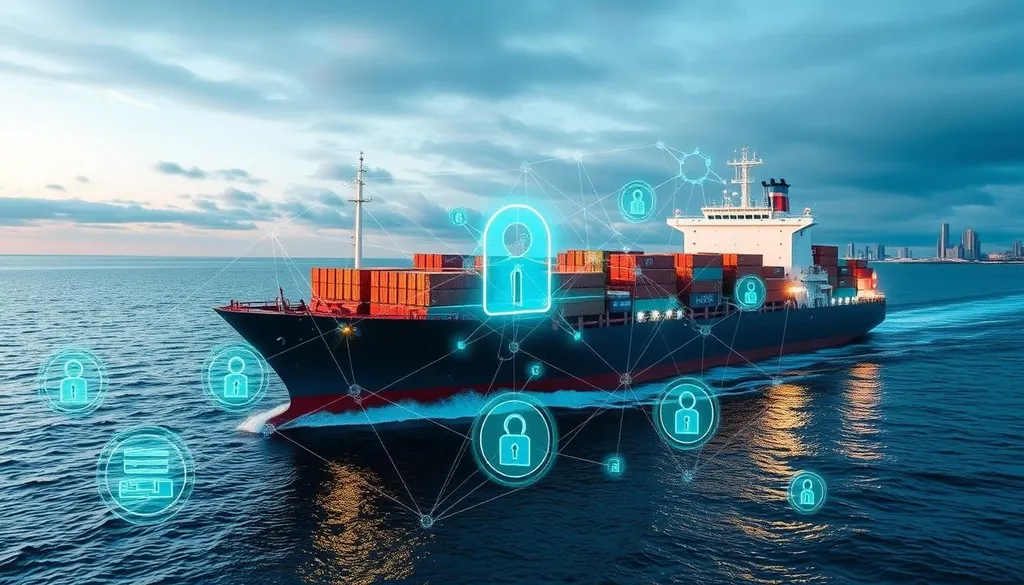
In the ever-evolving world of maritime logistics, a new study has emerged that could significantly impact how the industry operates. Published in the journal ‘Logistics’ (translated from Spanish), the research, led by Christian Muñoz-Sánchez from the Escuela Superior de Comercio y Administración Unidad Santo Tomás at the Instituto Politécnico Nacional in Mexico City, sheds light on the potential of blockchain technology to revolutionize maritime supply chains.
So, what’s the big deal about blockchain in maritime logistics? Well, imagine a digital ledger that’s tamper-proof, transparent, and shared among all parties involved in a shipment. This is essentially what blockchain offers. The study, a systematic literature review, analyzed 78 peer-reviewed articles to identify key themes and research priorities.
According to Muñoz-Sánchez, “Blockchain’s primary advantages are enhanced data integrity and visibility.” This means that every transaction, from the moment a container is loaded onto a ship to its final destination, can be tracked and verified in real-time. This transparency can help prevent fraud, reduce errors, and improve overall efficiency.
But it’s not all smooth sailing. The study also highlights several challenges. “Key challenges include interoperability, legal/regulatory uncertainty (e.g., e-doc recognition), high costs, scalability ceilings, integration with legacy systems, and data governance fears,” Muñoz-Sánchez notes. In other words, while blockchain has immense potential, there are still hurdles to overcome before it can be widely adopted in the maritime industry.
The study identifies seven research priorities for blockchain in maritime logistics: Technological Interoperability, Economic and Operational Impact, Cybersecurity and Privacy, Adoption and Scalability, Decision-Making and Trust, Environmental Sustainability, and Standardization and Regulatory Frameworks. These priorities provide a roadmap for future research and development in this area.
For maritime professionals, the implications are significant. Blockchain technology could streamline operations, reduce costs, and enhance security. It could also open up new opportunities for innovation and collaboration. However, it’s crucial to address the identified challenges to fully realize these benefits.
As the study concludes, the application of blockchain in maritime logistics depends on combined technical and institutional enabling conditions. An Integrated Blockchain Adoption Framework (IBAF) is suggested, along with practical guides based on standardization, legal convergence, and hybrid governance modes.
In the dynamic world of maritime logistics, blockchain technology is a game-changer. It’s not just about keeping up with the latest trends; it’s about embracing innovations that can drive efficiency, transparency, and growth. As the industry navigates these waters, the insights from this study could prove invaluable.