
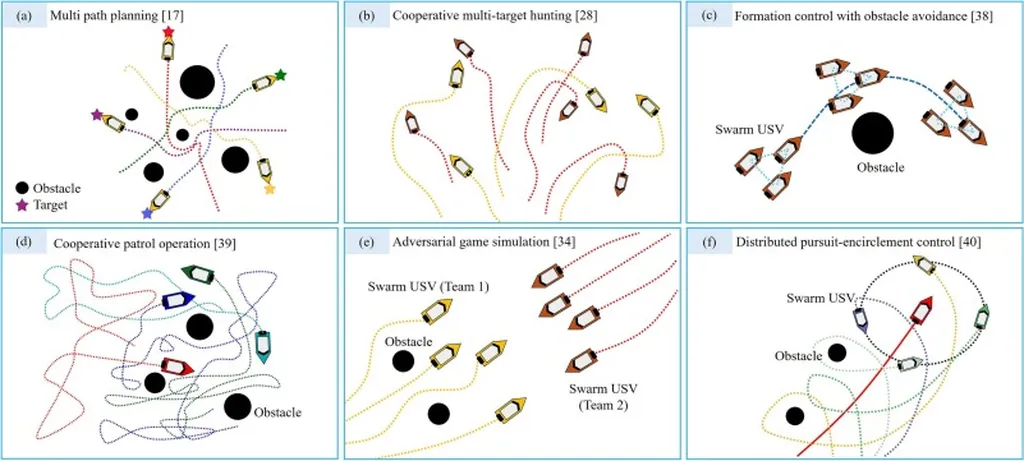
In the ever-evolving landscape of maritime defense and security, a novel approach to managing swarms of unmanned surface vehicles (USVs) is making waves. Researchers, led by Nur Hamid from the Interdisciplinary Research Center for Smart Mobility and Logistics (IRC-SML) at King Fahd University of Petroleum & Minerals in Saudi Arabia, have developed a sophisticated reinforcement learning framework that promises to revolutionize how these robotic vessels tackle multiple targets.
So, what’s the big deal? Well, imagine a scenario where a fleet of USVs needs to quickly detect and intercept several attackers. The challenge lies in efficiently assigning targets to the defenders without causing instability or inefficiency due to frequent reassignments. Hamid and his team have tackled this issue head-on with their ETA-hysteresis-guided reinforcement learning framework.
Here’s the gist of it: the system uses an estimated time of arrival (ETA) module to select the most suitable defender-target pair. But what sets this approach apart is the integration of a dual-threshold hysteresis mechanism. This clever addition prevents oscillatory reassignments triggered by minor changes in ETA values, ensuring a balance between responsiveness and stability.
The results speak for themselves. In a 3D-simulated water environment, the proposed method showed significant improvements over basic MAPPO and MAPPO-LSTM algorithms. It achieved faster convergence speed, higher interception rates, and reduced mean time-to-capture, all while maintaining competitive path smoothness and energy efficiency.
“This approach not only enhances the effectiveness of swarm USV operations but also ensures their stability and scalability,” Hamid explained. The findings, published in the journal ‘Applied System Innovation’ (translated to English as ‘Applied System Innovation’), highlight the potential of integrating time-aware assignment strategies with reinforcement learning for maritime security applications.
For the maritime industry, the implications are substantial. The ability to efficiently and effectively manage swarms of USVs can enhance maritime defense capabilities, improve security operations, and even optimize commercial activities like offshore inspections and environmental monitoring.
As Hamid puts it, “The integration of time-aware assignment strategies with reinforcement learning opens up new avenues for robust and scalable swarm USV operations.” This innovation could well be the tide that lifts many boats in the maritime sector.