
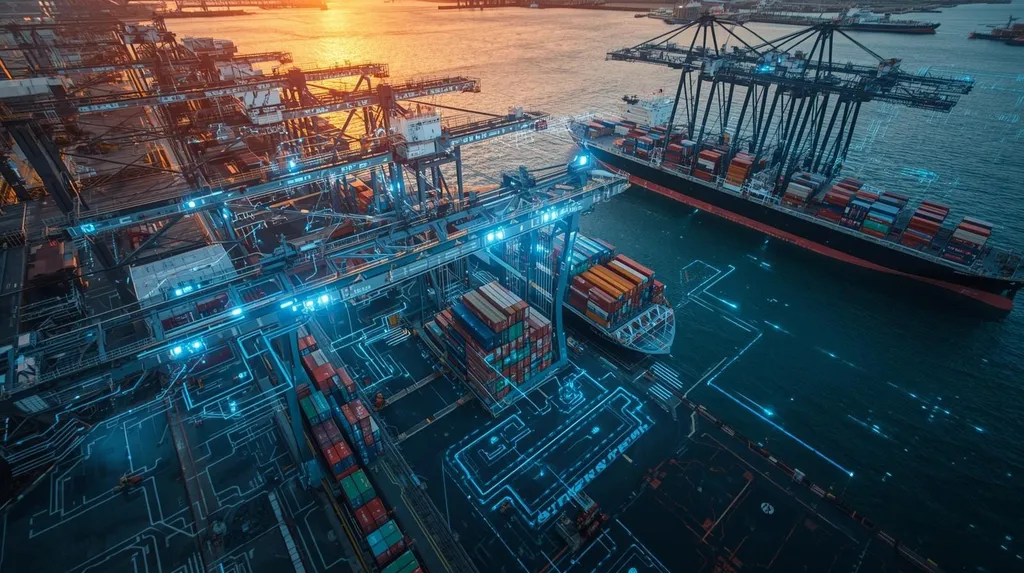
In the ever-evolving world of maritime transport, a shift is underway that’s not just about upgrading old systems but reimagining how ports operate entirely. This digital transformation, as outlined in a recent article published in the Encyclopedia, is reshaping port logistics, making it more efficient, resilient, and sustainable. At the helm of this research is Zhenqing Su, a professor at The Graduate School of Global Business, Kyonggi University in South Korea.
So, what’s driving this change? It’s not just about swapping paper for pixels. Su explains, “Digital transformation involves reconfiguring organizational structures, decision-making logics, and value creation models around connectivity, automation, and predictive intelligence.” In plain terms, it’s about using advanced tech to make smarter decisions, automate processes, and predict what’s coming down the line.
Imagine a port where sensors (Internet of Things) monitor everything from container weights to air quality, all connected via super-fast 5G networks. Where digital twins—virtual replicas of physical assets—help optimize operations. Where blockchain ensures secure, transparent trade documentation. Where AI predicts vessel arrivals and cargo needs, reducing wait times and improving efficiency. This isn’t science fiction; it’s the future of port logistics, as described by Su.
But what does this mean for the maritime sector? The opportunities are vast. For starters, it’s about cutting costs and improving efficiency. By automating processes and reducing bottlenecks, ports can handle more cargo, faster. It’s also about resilience. With predictive intelligence, ports can better prepare for disruptions, whether it’s bad weather or a sudden surge in cargo.
Then there’s sustainability. Digital transformation can help ports meet decarbonization goals by optimizing operations and reducing emissions. Plus, it can open up new business models and revenue streams. As Su notes, “The purpose of digital transformation is not only to improve efficiency and reduce operational bottlenecks, but also to enhance resilience against disruptions, ensure sustainability in line with decarbonization goals, and reposition ports as orchestrators of trade networks rather than passive providers of physical infrastructure.”
For maritime professionals, this means upskilling and adapting to new technologies. It’s a challenge, yes, but also a huge opportunity. Those who embrace this digital transformation will be at the forefront of the industry, driving innovation and shaping the future of maritime transport.
So, as the maritime industry stands on the brink of this digital revolution, one thing is clear: the future of port logistics is not just about keeping up with the times, but leading the charge. And with researchers like Zhenqing Su at Kyonggi University shedding light on these trends, the industry is well-equipped to navigate this exciting new era.