
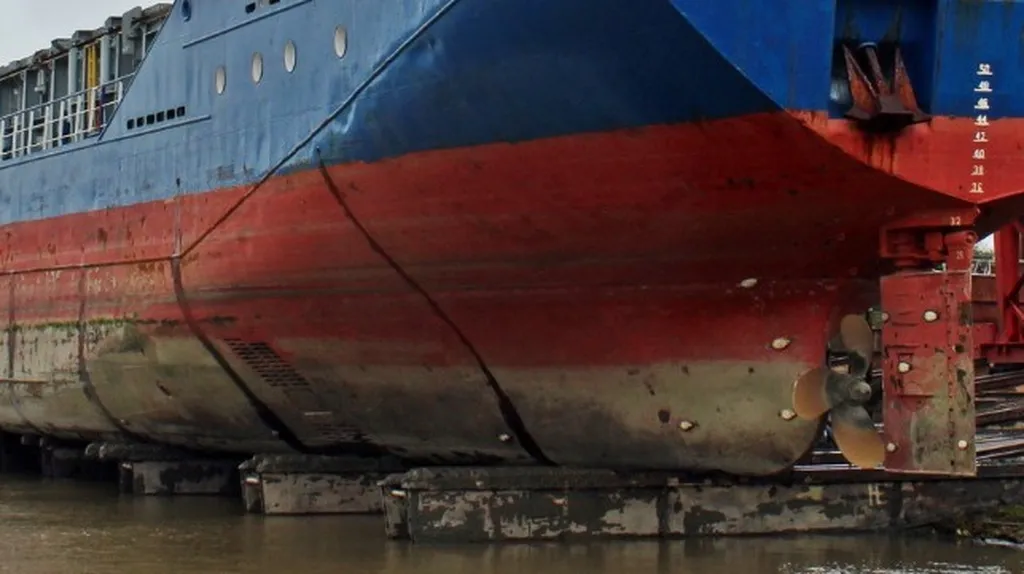
In a significant study published in the *Journal of Marine Science and Engineering*, researchers have shed light on the environmental impact of microplastics (MPs) and antifouling paint particles (APPs) from ship-hull derusting wastewater. The research, led by Can Zhang from the Department of Environmental Science and Engineering at Tongji University in Shanghai, provides a comprehensive analysis of these pollutants, their concentrations, and their potential to harm marine ecosystems.
The study focused on wastewater generated by ultra-high-pressure water jetting during ship-hull maintenance. The findings revealed that this wastewater contains a substantial amount of MPs and APPs. Specifically, the total suspended solids (TSS) concentration was measured at 20.04 grams per liter, with MPs and APPs making up a significant portion of this. The researchers identified six types of MPs at a total concentration of 3.29 milligrams per liter and quantified APPs at 330.25 milligrams per liter, representing 1.65% of the TSS.
Particle size distribution was also a key focus of the study. The particles ranged in size from 3.55 to 111.47 micrometers, with a median size of 31 micrometers. APPs were primarily found to be between 5 and 100 micrometers, with 81.4% of them being smaller than 50 micrometers. This size range is particularly concerning because smaller particles can disperse more widely and penetrate deeper into marine ecosystems.
The study extrapolated these findings to estimate the annual generation of wastewater from ship-hull maintenance activities. Based on the treated ship-hull surface area in 2024, the researchers projected the production of approximately 57,440 cubic meters of wastewater. This wastewater is estimated to contain around 0.2 tons of MPs and 19 tons of APPs.
Can Zhang emphasized the urgency of addressing this issue, stating, “These findings highlight the magnitude of pollutant release from ship maintenance activities and underscore the urgent need for targeted treatment technologies and regulatory policies to mitigate microplastic pollution in marine environments.”
The commercial implications of this research are substantial. Shipyards and maritime companies will need to invest in advanced treatment technologies to manage and reduce the release of MPs and APPs. This presents an opportunity for innovation in wastewater treatment solutions tailored to the maritime industry. Additionally, regulatory bodies may need to update their policies to address these emerging pollutants, potentially leading to new compliance requirements for shipyards and maintenance facilities.
The study’s findings, published in the *Journal of Marine Science and Engineering* (translated from Chinese as the *Journal of Ocean Science and Engineering*), provide a critical foundation for understanding the environmental impact of ship-hull maintenance activities. As the maritime industry continues to evolve, it is essential to prioritize sustainable practices that protect marine ecosystems from the harmful effects of MPs and APPs.