
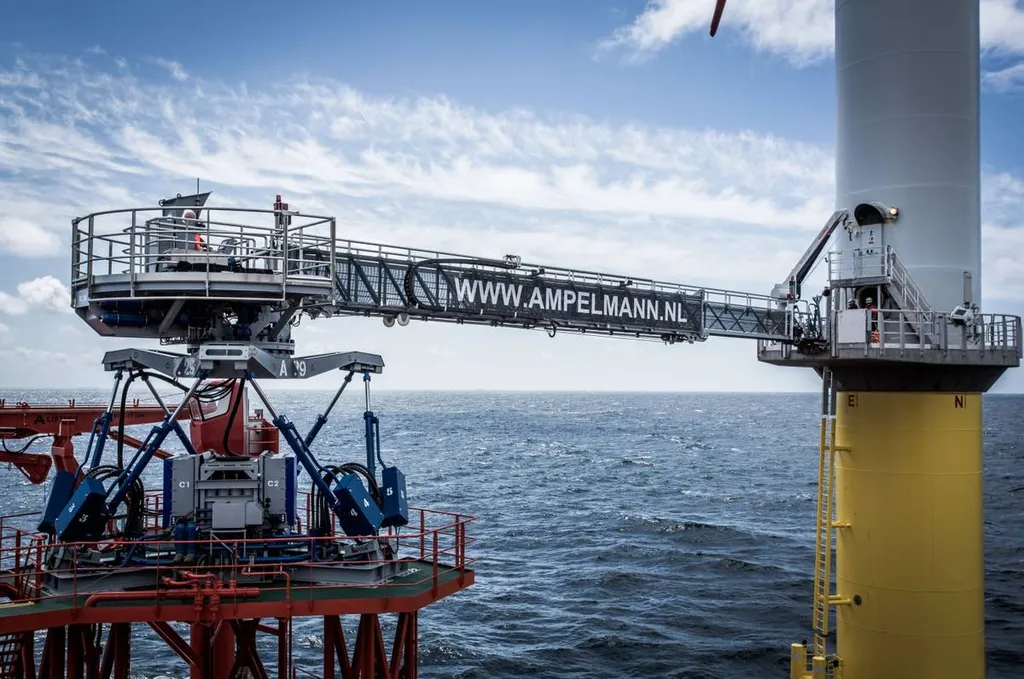
In the bustling world of offshore wind energy, where the stakes are high and the seas are often unforgiving, a team of researchers led by Hongyan Mu from Tsinghua Shenzhen International Graduate School has made a significant stride in improving the safety and efficiency of personnel transfers. Their work, published in the Journal of Marine Science and Engineering, focuses on a system that could very well become a game-changer for the industry: an active motion-compensated gangway for service operation vessels (SOVs).
So, what’s the big deal? Well, imagine trying to walk from a moving ship to an offshore wind turbine in choppy seas. It’s not just a matter of balancing—it’s about safety, efficiency, and, ultimately, the success of operation and maintenance (O&M) activities. That’s where Mu’s team comes in. They’ve developed a sophisticated simulation framework that models the complex dynamics of an SOV equipped with an active motion-compensated gangway. Think of it as a high-tech bridge that adjusts in real-time to the vessel’s movements, minimizing the impact of waves and wind.
The team’s approach is a blend of cutting-edge technology and innovative control strategies. They used potential flow theory and frequency-domain multi-body hydrodynamics to create a numerical model of the SOV. This model predicts the vessel’s motions, which are then used as inputs for a co-simulation environment that represents the gangway. The gangway itself is based on a Stewart platform, a sophisticated piece of engineering that can adjust its position and orientation in six degrees of freedom.
But here’s where it gets really interesting. To tackle the system’s nonlinearity and coupling, the researchers proposed a composite control strategy that integrates velocity and dynamic feedforward with three-loop PID feedback. In plain English, this means the gangway doesn’t just react to the vessel’s movements—it anticipates them, making adjustments before the waves even hit. The results speak for themselves: the composite strategy achieved an average disturbance isolation degree of 21.81 dB, significantly outperforming traditional PID control.
Mu and her team didn’t just stop at simulations. They validated their findings using a ship motion simulation platform and a combined wind–wave basin with a 1:10 scaled prototype. The experimental results confirmed high compensation accuracy, with heave variation maintained within 1.6 cm and a relative error between simulation and experiment of approximately 18.2%. As Mu puts it, “These findings demonstrate the framework’s capability to ensure safe personnel transfer by effectively isolating complex vessel motions.”
So, what does this mean for the maritime industry? For starters, it’s a significant step forward in making offshore wind operations safer and more efficient. With the global push for renewable energy, the offshore wind sector is booming, and any technology that can improve O&M activities is a welcome addition. Moreover, the principles behind this technology could potentially be applied to other areas of maritime operations, from offshore oil and gas to shipping and logistics.
The commercial impacts are substantial. SOVs equipped with active motion-compensated gangways could become the new standard for personnel transfers, reducing downtime and improving safety. This could lead to cost savings for operators and, ultimately, more affordable and reliable renewable energy for consumers.
In the words of the researchers, “These findings demonstrate the framework’s capability to ensure safe personnel transfer by effectively isolating complex vessel motions.” It’s a bold claim, but the data backs it up. As the offshore wind industry continues to grow, technologies like these will be crucial in navigating the challenges that lie ahead. And with researchers like Hongyan Mu and her team at Tsinghua Shenzhen International Graduate School leading the charge, the future of offshore wind operations looks brighter than ever.