
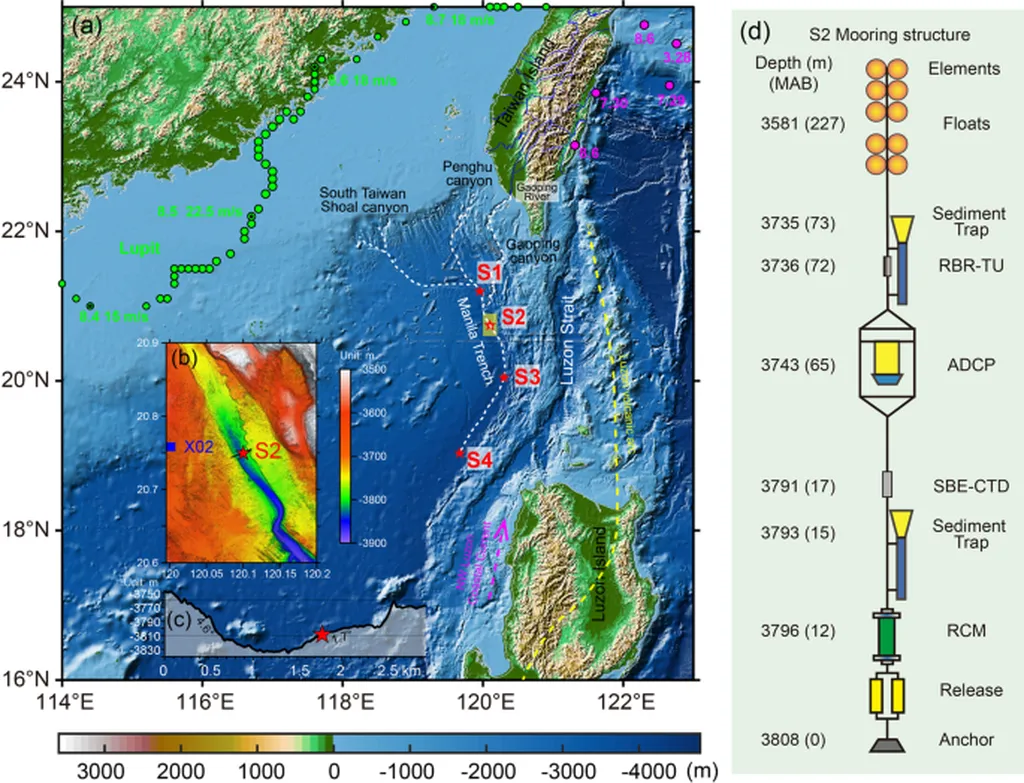
In the depths of the northern South China Sea, a fascinating geological phenomenon is unfolding near the Manila Trench, and it’s caught the attention of marine scientists. Yuping Yang, a researcher at the National Engineering Research Center of Port Hydraulic Construction Technology in Tianjin, China, has been leading a team that’s been using high-resolution multibeam bathymetric data to study the area. Their findings, recently published in *Frontiers in Marine Science* (which translates to “Frontiers in Marine Science” in English), shed light on the formation and evolution of cyclic steps in submarine canyons, which could have significant implications for the maritime industry.
So, what are cyclic steps? Imagine underwater staircases, but instead of being carved by human hands, they’re shaped by powerful underwater currents called turbidity currents. These currents carry sediment and other materials down the seafloor, creating these step-like features. Yang and his team identified 23 of these cyclic steps near the Manila Trench, dividing them into two main types: net-erosional (Type A) and net-depositional (Type B) steps.
Type A steps, which are larger and occur downstream of major canyons like the South Taiwan Shoal Canyon and Penghu Canyon, are formed by the erosive power of turbidity currents. These currents, confined within the canyons, carve out the seafloor, creating these steps. On the other hand, Type B steps are smaller and form outside the canyon levees, adjacent to canyon bends. They’re created by unconfined turbidity currents that deposit sediment as they flow.
The team used a statistical method called Principal Component Analysis (PCA) to distinguish between the two types of steps. “The PCA distinctly identifies the two cyclic step clusters (Types A and B),” Yang explained. “Cyclic steps length (Lstep) and height (Hstep) are key explanatory variables.”
But why should the maritime industry care about these underwater staircases? Well, for starters, they play a crucial role in material transport and deposition in the deep sea. Type A steps, in particular, are likely to evolve into new submarine canyon-channel systems under continued erosion. This could alter sediment transport patterns, potentially impacting underwater infrastructure like cables and pipelines.
Moreover, understanding these processes can help in predicting and mitigating geohazards like submarine landslides and turbidity currents, which can pose risks to offshore installations. It can also aid in the exploration and exploitation of deep-sea resources, as well as in the design of underwater structures that can withstand these powerful currents.
In essence, Yang’s research is not just about uncovering the secrets of the deep sea. It’s about providing valuable insights that can help the maritime industry navigate and harness the underwater world more safely and sustainably. As Yang put it, “Our results improve understanding of the origin and formation of cyclic steps in global submarine canyons.” And that understanding could be a game-changer for the maritime sectors.