
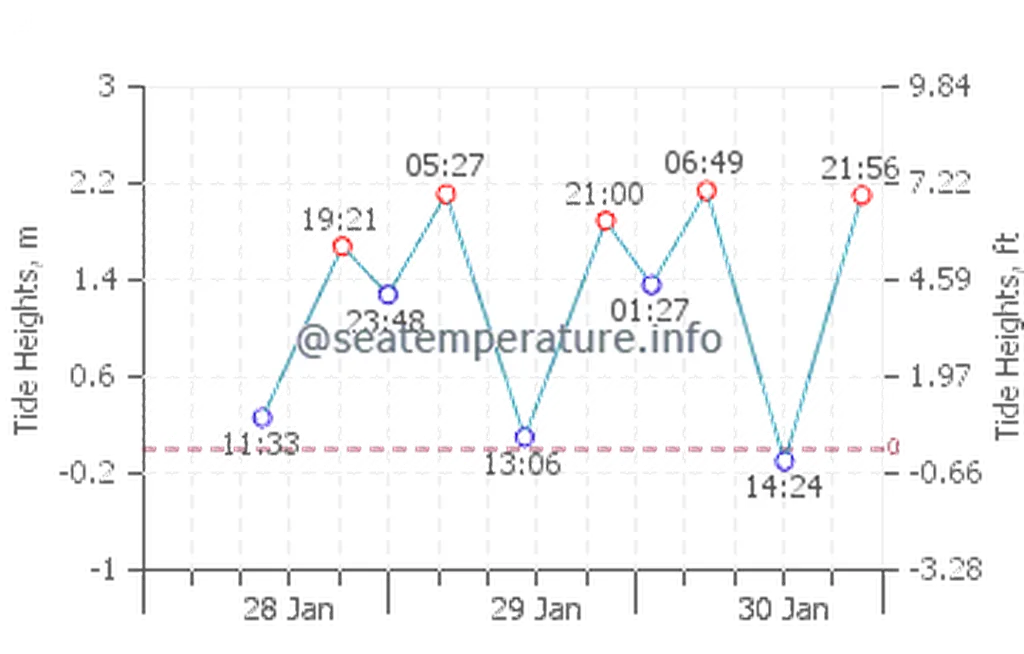
In the bustling maritime hub of Bintan Island, Indonesia, a recent study has shed light on the intricate dance of tides that sway the coastal waters, with significant implications for port operations and coastal management. Led by M. Hasbi Sidqi Alajuri from the Raja Ali Haji Maritime University, the research, published in the Journal of Applied Geospatial Information, delves into the spatial variability of tidal characteristics at three key locations: Bakau Bay, Tanjung Uban Port, and Moco Port.
Alajuri and his team utilized global tidal prediction data and harmonic analysis to examine eight principal tidal constituents, revealing a complex tidal tapestry. The findings indicate that while the lunar-driven M₂ constituent dominates tidal behavior across all sites, the contributions from diurnal constituents like K₁ and O₁ result in mixed tidal regimes. “The Formzahl values of 1.10 at Bakau Bay, 0.66 at Tanjung Uban, and 1.29 at Moco classify all sites as mixed tides with a predominance of semidiurnal components,” Alajuri explained.
So, what does this mean for the maritime industry? Understanding tidal variability is crucial for port operations, ensuring safe and efficient navigation. For instance, Tanjung Uban, with its stronger tidal influence, may require more frequent adjustments to docking schedules and vessel movements. Meanwhile, the knowledge of mixed tidal regimes can aid in coastal planning, helping to mitigate erosion and manage sediment transport.
The study also highlights the role of local coastal morphology in tidal amplitudes. This insight can be particularly valuable for maritime infrastructure development, guiding the design and placement of ports and other coastal structures. As Alajuri noted, “This multi-location analysis provides a comprehensive understanding of spatial tidal variability in Bintan coastal waters and supports coastal planning, port management, and hydrodynamic modeling in the region.”
For maritime professionals, this research underscores the importance of site-specific tidal data in decision-making processes. It’s a reminder that even in close proximity, tidal characteristics can vary significantly, impacting operations and planning. As the maritime industry continues to evolve, such detailed studies will be instrumental in navigating the complex tidal landscapes of our coastal waters.
In essence, Alajuri’s work serves as a beacon, illuminating the path for safer, more efficient, and sustainable maritime practices in Bintan Island and beyond.