
In the world of maritime electrification, managing battery temperatures is a bit like trying to keep a room full of toddlers calm—it’s a complex, delicate task that can make or break the whole operation. Enter Yankong Song, a researcher from the College of Maritime Electrical Engineering at Dalian Maritime University in China, who’s just published a study in the journal ‘Future Batteries’ (translated from the Chinese title ‘未来电池’) that might make this job a whole lot easier.
Song and his team have developed a reduced-order thermal model (ROTM) for battery thermal management systems (BTMS). Now, that’s a mouthful, but let’s break it down. Think of it like this: you’ve got a battery pack, and you need to keep it cool. You’ve got sensors and software working together to manage the temperature, but the system’s not perfect. There’s something called thermal hysteresis—basically, the battery’s temperature doesn’t always respond predictably to changes. This makes it tough to control precisely.
The team’s solution? They’ve used a couple of fancy mathematical techniques—proper orthogonal decomposition (POD) and Galerkin projection—to create a simplified, or ‘reduced-order,’ model of the battery’s thermal behavior. Here’s how Song explains it: “The ROTM can thus be obtained.” Okay, maybe that’s not the simplest explanation, but bear with me.
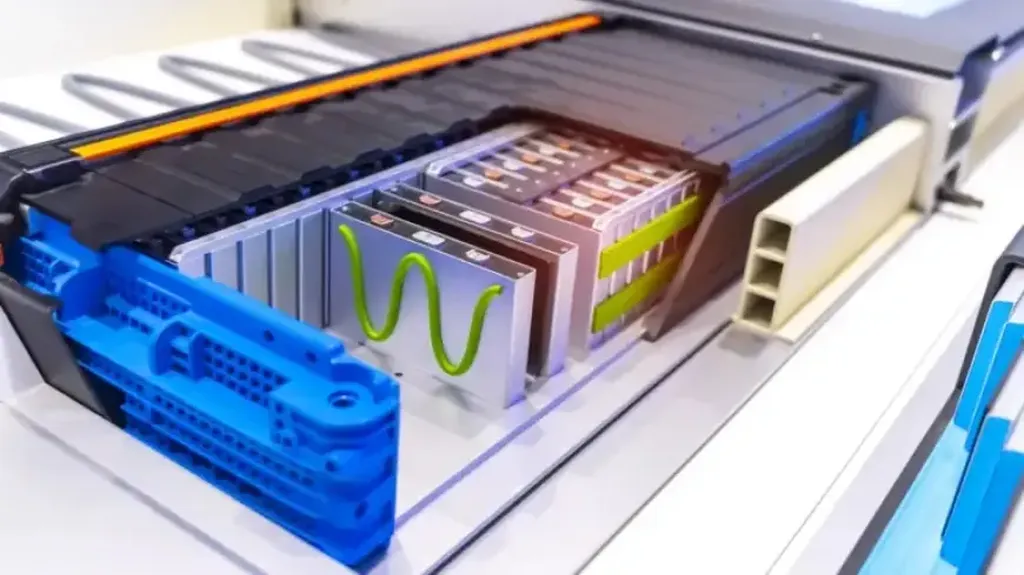
First, they built a detailed computer model of a battery module—imagine a pack of eight batteries in series and three in parallel, with air cooling. Then, they used POD to extract the most important information about how the air flows and the temperature changes within this module. Finally, they applied Galerkin projection to simplify the complex equations that describe these changes.
The result? A model that’s way faster to compute than the original detailed model, but still accurate. In fact, it’s about 10,000 times faster, with a maximum error of less than 0.2°C under constant-current conditions. That’s like being able to read a summary of a book instead of the whole thing, but still understanding the plot.
So, what does this mean for the maritime sector? Well, as ships increasingly turn to electric and hybrid propulsion, managing battery temperatures effectively is crucial. It’s all about reliability, safety, and efficiency. A system like this could help optimize battery performance, extend battery life, and reduce the risk of overheating—all of which are big deals for ship operators.
Moreover, this kind of technology could open up new opportunities for maritime companies to innovate and stay ahead of the curve. As Song puts it, “The ROTM exhibits a significantly reduced computational time and maintains adequate accuracy.” In other words, it’s a tool that could help the maritime industry navigate the complex waters of battery management with greater ease and confidence.
So, while it might not be the most glamorous topic, battery thermal management is a big deal in the world of maritime electrification. And with researchers like Yankong Song and his team working on solutions, the future of battery management in the maritime sector is looking brighter—and cooler—than ever.