
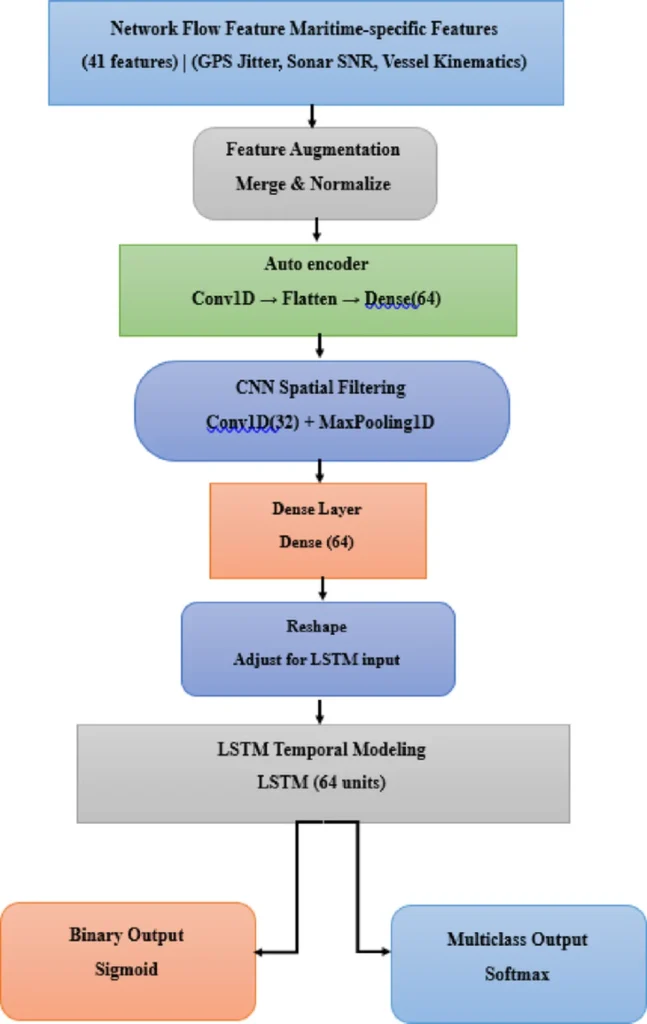
In a significant stride towards bolstering maritime cybersecurity, researchers have developed a novel deep learning approach to detect intrusions in maritime radar networks. The study, led by Md Mostofa Nurannabi Shakil from the NTRCA, ICT Cell, Ministry of Education, introduces MARINERNet, a deep learning-based intrusion detection system tailored for maritime radar networks. Published in the journal Scientific Reports, the research addresses the growing vulnerability of interconnected maritime systems to cyber-attacks, which pose substantial risks to critical infrastructure.
Maritime radar networks are vital for ensuring the safety and security of maritime operations. However, their increased interconnectivity has made them prime targets for cyber-attacks. Traditional intrusion detection systems (IDS) often fall short in detecting sophisticated and evolving attacks in real-time due to their reliance on manual feature extraction and shallow machine learning techniques. MARINERNet, on the other hand, uses a novel architecture that integrates 1D convolutional layers, squeeze-and-excitation blocks, and residual connections to automatically extract relevant features from raw radar network data. This automation enhances detection accuracy without the need for manual intervention.
The system’s performance is impressive, achieving 98.52% accuracy for multiclass classification and perfect accuracy for anomaly detection (binary classification). “The approach is scalable, capable of handling large datasets, and adaptable to real-time intrusion detection, making it suitable for deployment in dynamic radar environments,” Shakil explained. This scalability and adaptability are crucial for the maritime sector, where conditions can change rapidly, and large volumes of data are generated continuously.
The commercial impacts of this research are substantial. Enhanced cybersecurity measures can protect maritime operations from financial losses due to cyber-attacks, which can disrupt operations and damage infrastructure. Additionally, the robustness and adaptability of MARINERNet make it a valuable tool for maritime professionals, ensuring the safety and security of their operations in an increasingly interconnected world.
Moreover, the research contributes to the broader field of cybersecurity by offering a robust, deep learning-based approach that can be applied to other network systems. This versatility opens up opportunities for collaboration and innovation across various industries, further solidifying the importance of this research.
In summary, MARINERNet represents a significant advancement in maritime cybersecurity. Its ability to detect intrusions accurately and efficiently makes it a valuable asset for maritime professionals. As the maritime sector continues to evolve, the need for robust cybersecurity measures will only grow, and MARINERNet is poised to meet this challenge head-on.