
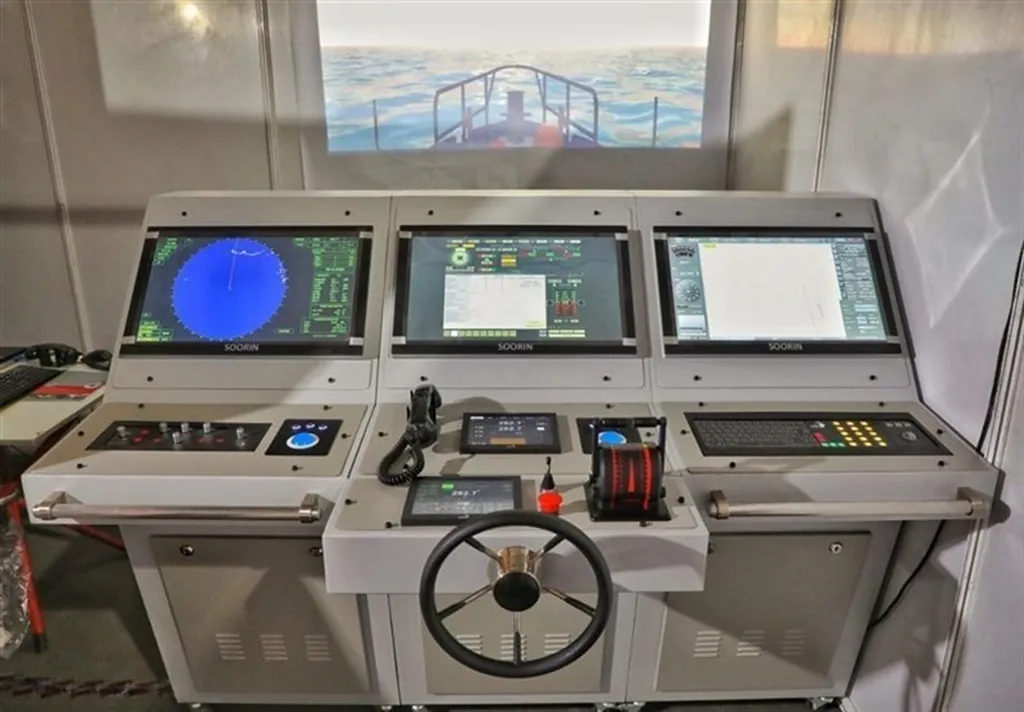
Iran has taken a significant stride in maritime training and simulation technologies with the development of a domestically built command bridge simulator. This advanced system can replicate operations for 300 different civilian and military vessels, showcasing the country’s growing technical expertise in this critical field.
The simulator has been introduced as a comprehensive educational tool for navigation and seafaring, capable of modelling a wide array of vessels. These range from lifeboats and small boats to large bulk carriers and military warships, according to those involved in the project.
Mohammad-Hossein Kardar, the operator and technical supervisor of the simulator, provided insights into its capabilities in an interview with Tasnim News Agency. He described the system as a multi-purpose tool designed for a wide range of civilian and military applications. “At present, we have data for 300 light and heavy vessels, covering everything from lifeboats to bulk carriers and warships,” Kardar said. He also noted that the project has successfully completed 14 initiatives.
Kardar highlighted that four maritime training schools in the southern and northern port cities of Bandar Abbas, Khorramshahr, Bandar Torkaman, and Chabahar have been equipped with the system. In addition to civilian use, the technology has been adapted for military purposes. “Two advanced military models, equipped with a combat information center (CIC) and a combat version, have also been launched for the army in Bushehr and Bandar Abbas,” he said.
The simulator is designed to replicate real-world maritime scenarios, allowing trainees to gain hands-on experience without the risks and costs associated with live training at sea. Such systems are widely used globally to improve safety standards and operational efficiency in both commercial shipping and naval operations.
Kardar emphasized the economic advantages of the domestically produced simulator. “The total cost of this simulator is variable, but on average, it is about one-third the price of comparable foreign models,” he said. This cost-effectiveness is a significant achievement, especially given the economic challenges Iran faces due to sanctions.
The focus, for now, remains on meeting domestic demand. “At present, there has been no export, and the focus is on internal customers, both military and educational,” Kardar said. He added that the system is continuing to evolve. “In addition to the command bridge, other sections such as an engine room simulator, liquid cargo loading operations, and cargo handling workshops are being added to this comprehensive system,” he noted.
This development underscores Iran’s commitment to advancing indigenous technologies, particularly in sectors linked to transportation, defence, and strategic infrastructure. As the simulator continues to evolve and expand its capabilities, it could play a crucial role in enhancing maritime training and operational readiness within the country.
The implications of this development extend beyond Iran’s borders. As maritime training and simulation technologies become increasingly sophisticated, countries around the world are investing heavily in these systems to ensure the safety and efficiency of their fleets. Iran’s achievement in this field could inspire other nations to explore similar paths, particularly those facing economic constraints or limited access to foreign technology.
Moreover, the focus on domestic production and development highlights a broader trend in the maritime industry towards self-sufficiency and innovation. As geopolitical tensions and economic sanctions continue to shape global trade and technology transfer, countries are increasingly looking inward to develop their capabilities.
In the long term, this could lead to a more diverse and resilient maritime industry, with multiple centres of innovation and expertise emerging around the world. For Iran, the development of this command bridge simulator is not just a technological achievement but a step towards greater self-reliance and strategic independence in the maritime domain.
As the simulator continues to be refined and expanded, it will be interesting to see how it influences maritime training and operations in Iran and potentially beyond. The focus on cost-effectiveness, versatility, and real-world applicability positions this technology as a valuable asset in the global maritime training landscape.