
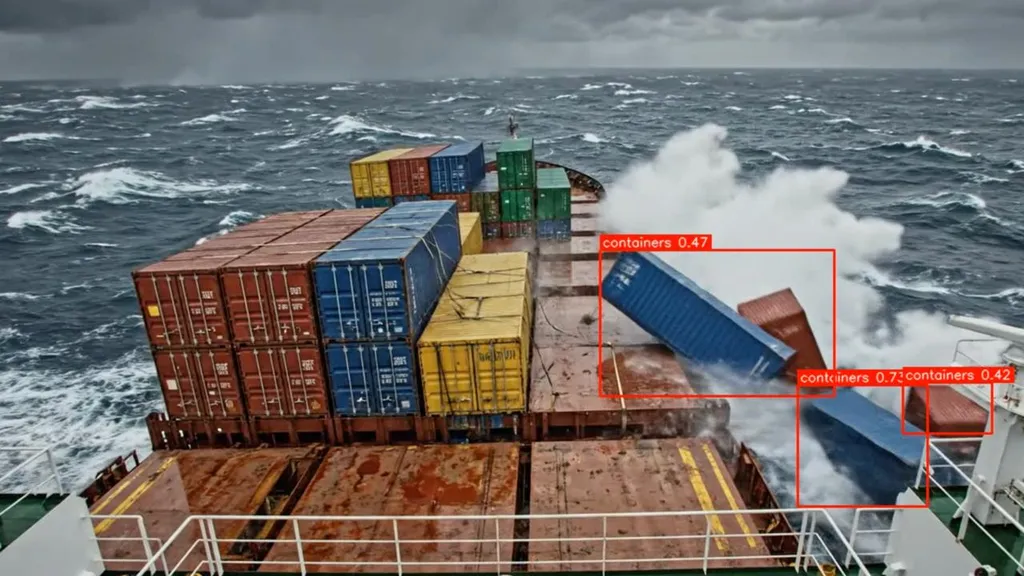
Eyesea and EVI Safety Technologies have launched an artificial intelligence system that could revolutionize maritime safety and environmental protection. The technology, which uses standard onboard cameras, is designed to detect and report containers lost overboard at sea. After extensive development and simulation testing, the system is now ready for real-world trials aboard operational vessels.
The system employs computer vision and machine learning to analyze imagery from deck and bridge cameras, automatically identifying and counting containers either falling from a ship or observed adrift. Once detected, critical incident data—including the position, number of containers, and details on contents, especially dangerous goods—can be instantly transmitted to registered vessel owners, flag states, and coastal authorities when appropriate.
This advancement comes as the maritime industry prepares for new mandatory reporting requirements under the International Maritime Organization (IMO), which took effect yesterday, January 1. The Eyesea-EVI solution is designed to support compliance with these rules by producing precise, geo-tagged imagery and structured incident data the moment a container is lost or spotted adrift.
Vladimir Ponomarfev, CEO of EVI Safety Technologies, expressed enthusiasm about the technology’s potential, stating, “It’s amazing to be able to apply the advances of machine learning and AI to help the maritime sector tackle an environmental and safety challenge that has been underserved for decades.” Beyond regulatory compliance, the real-time detection and automated reporting system addresses a longstanding maritime challenge: container loss events often occur without witnesses or are reported too late to alert other vessels, putting navigation safety, supply chains, and the marine environment at risk.
Graeme Somerville-Ryan, Founder of Eyesea, highlighted the urgency of such innovations, noting, “With this new technology now ready to move on from simulation testing, we’re taking a major step forward in real-world detection and environmental protection.” The urgency is underlined by a recent event where 45 containers fell overboard from the ONE Continuity in mid-December.
Significant progress has been made in recent years to address the root causes of container losses, enhance cargo securing, and develop tools and training for ocean carriers and seafarers. The rollout of the Eyesea-EVI system marks a critical step forward, aligning technological advances with upcoming regulatory changes and industry best practices. The next phase will see onboard trials, with broader deployment anticipated following successful real-world validation.
As containerized trade continues to expand, ensuring that technology, regulation, and operational excellence work hand in hand is essential to safeguarding both shipping operations and the marine environment. This new system could be a game-changer, providing a robust solution to a persistent problem and setting a new standard for maritime safety and environmental stewardship.