
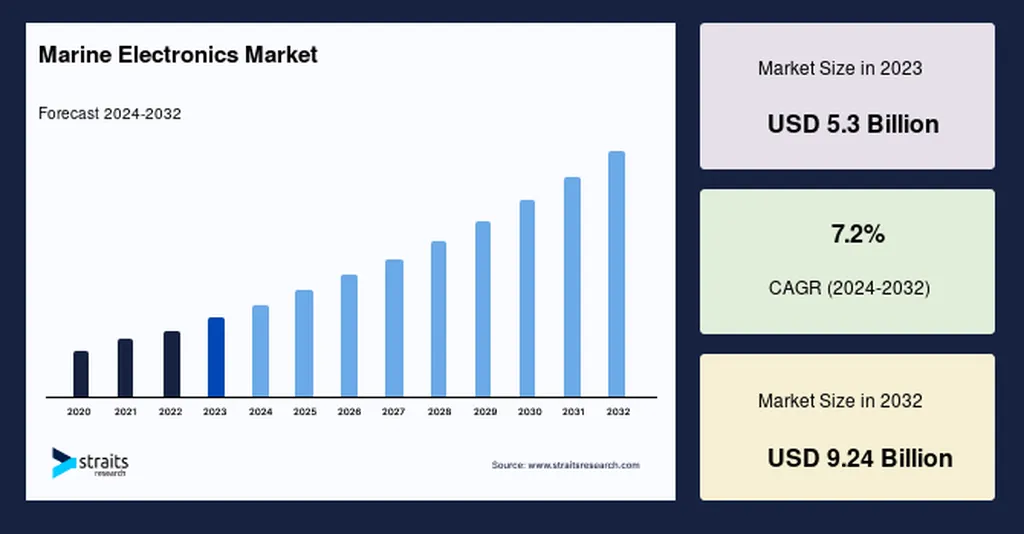
The marine electronics market is riding a wave of innovation, with a projected 5.3% CAGR through 2031, driven by IoT, AI, and sustainable tech. As global trade and leisure boating surge, the demand for advanced marine electronics is skyrocketing. Key segments like GPS/radar, SONAR, and communication devices are evolving rapidly, catering to commercial fleets, recreational yachts, and naval operations. Recent updates from industry leaders like Garmin, Furuno, and Simrad highlight the rapid pace of technological advancement in this sector.
Garmin’s strategic satellite partnerships and Furuno’s AI-driven sonar advancements are just a few examples of how the industry is leveraging cutting-edge technology to enhance navigation, safety, and efficiency. Simrad’s FishCast tool, which integrates AI for fishing intelligence, is another testament to the innovative spirit driving the market forward. These developments are not just about improving performance; they’re about creating smarter, greener solutions that can meet the growing demands of the maritime industry.
The marine electronics market is a diverse landscape, encompassing everything from GPS and radar systems to SONAR modules and communication devices. Autonomous Identification Systems (AIS) are revolutionizing collision prevention through real-time vessel tracking, while thermal and visible cameras are enhancing nighttime surveillance. Multi-function navigation displays are consolidating data for intuitive control, and innovations like autopilots and audio-video setups are pushing the boundaries of what’s possible at sea.
As the market evolves, the focus is increasingly on integration and resilience. Companies like Kongsberg Maritime and Navico are emphasizing the need for robust, interconnected solutions that can withstand the harshest maritime conditions. This trend is likely to continue, with a growing emphasis on AI predictive maintenance, cloud data exchange, and eco-friendly power solutions.
Regionally, North America is leading the charge with a significant share of the market, driven by recreational boating and tech leaders like Garmin. The Asia Pacific region is growing rapidly, fueled by port upgrades and shipping booms in China and India. Europe, meanwhile, is setting the pace for regulations and innovations, with companies like Kongsberg and Furuno at the forefront.
The future of the marine electronics market looks bright, with a steady CAGR of 5.3% expected through 2031. As the industry continues to innovate, we can expect to see stronger adoption of autonomous vessels, fusion of radar, sonar, and camera technologies, and a growing emphasis on IoT, AR/VR, and cybersecurity. With these advancements, the maritime industry is poised for a future that is safer, smarter, and more sustainable.
As Andrea Olivi, Global Head of Shipping at Trafigura, puts it, “This partnership marks an important step in Trafigura’s commitment to improving efficiency and sustainability across its maritime operations.” The marine electronics market is not just about keeping up with the times; it’s about setting the pace for the future of maritime technology.